The Cost of Politics for Ghana’s Aspiring Young Parliamentarians
Democracy costs money, and so does politics. Indeed, money plays a critical role in politics, elections, and democracy globally.[i] Political parties cannot function without financial resources, nor can political debates and campaigns. However, when the cost of politics is too high, it triggers concerns about exclusion.
Ghana’s return to multiparty democracy in 1992 ushered in elections that enabled broad political participation. Yet limited financial resources have hindered fair engagement, creating an exclusionary barrier for groups such as women and young people. Still, Ghana’s rate of youth political participation highlights notable progress and provides an opportunity to create more inclusive pathways for young people to influence policy, assume leadership roles, and shape the nation’s democratic future.[ii]
Through an intersectional lens that considers youth, gender, and political-party membership, this study seeks to understand the cost of politics in Ghana. Intersectionality explains how overlapping social identities interact to produce unique experiences. Applying an intersectional lens guides participant recruitment and reveals how combined identities shape the costs of politics in ways a single-axis analysis would ordinarily overlook. The study explores how young men and women affiliated with Ghana’s two dominant political parties – the governing National Democratic Congress (NDC) and the opposition New Patriotic Party (NPP) – finance their parliamentary aspirations.

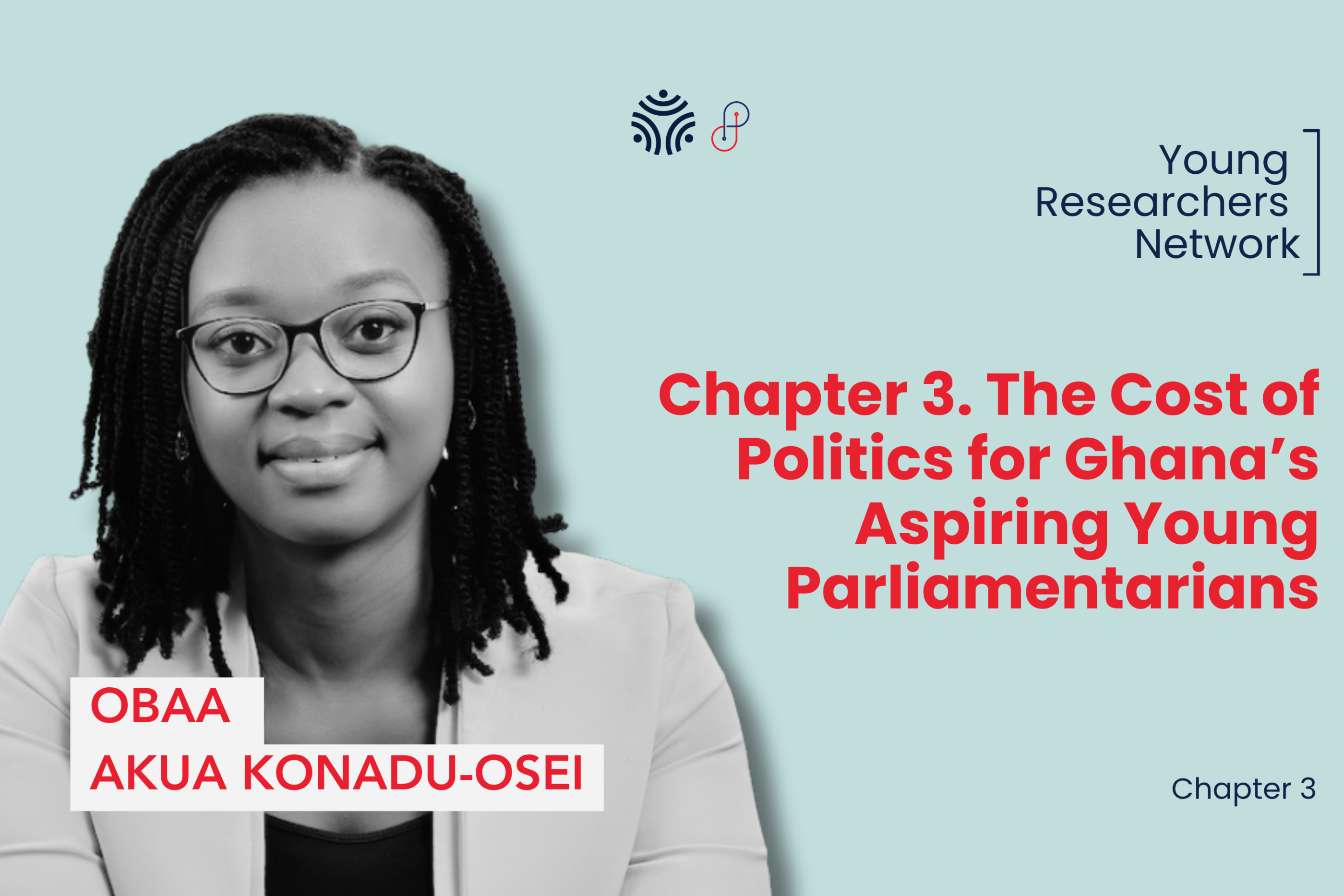
Obaa Akua Konadu-Osei holds a PhD in Business Management and is a Teaching Fellow at Maastricht University, with expertise in youth participation, gender equality, and sustainable development across academic, policy, and international development platforms.
Methodology
This chapter is based on an intersectional, qualitative, comparative study involving 12 Ghanaians between the ages 21 of 40 who were hoping to enter parliament: three men and three women from each of the two main parties, the NDC and the NPP. The study received ethical approval from Maastricht University’s Ethical Review Committee.
Interviews were conducted remotely, and participants chose pseudonyms to conceal their identities. To maintain confidentiality, any data that could indirectly identify the participants were hidden. All interviews were conducted before Ghana’s 2024 general elections.
The costs of entering politics
The cost of politics encompasses the many expenses that aspiring candidates incur, from their initial decision to run for election through to their time in office.[iii] Traditionally framed in economic terms, this cost has been broadened in contemporary studies to emphasise non-financial aspects, such as the social, physiological, emotional, and physical costs that accompany political engagements.[iv] This study considers both dimensions.
The situation in Ghana
Since Ghana’s return to multiparty democracy in 1992, power has alternated every eight years between the NDC and the NPP, with the two parties dominating the country’s parliament. Party members who want to enter the legislature must first secure the votes of party delegates at primaries. If successful, members become parliamentary candidates on their party’s ticket at the next general elections, which are held every four years.
A 2022 study by the Westminster Foundation for Democracy into the cost of politics in Ghana showed a 59% increase in campaign costs between 2012 and 2016, underscoring that a parliamentary hopeful’s financial capacity is a crucial determinant of their success.[v]
The country’s de facto two-party, winner-takes-all system concentrates patronage on the winning party, inflating costs.[vi] Private financing from powerful and wealthy individuals and interest groups for political activities, while common in many democracies, has fuelled widespread dissatisfaction with the culture of money – or vote buying – in Ghana’s political landscape.[vii] The National Commission for Civic Education, civil society groups, think tanks, academics, and traditional and religious leaders have all warned that excessive monetisation may make politics the exclusive preserve of the wealthy, foster corruption, and undermine participatory and inclusive democratic norms.[viii]
Political costs
All research participants in this study noted the costly process of securing a spot as their party’s parliamentary candidate. Expenditure can be broadly categorised as travel and transport, social interventions, filing fees, publicity materials, community entry and engagements, gifts for and demands from constituents, or general campaign costs. Community entry, a major pre-primaries expense, involves paying homage to the owners of the land, including traditional and opinion leaders – a common practice in many Ghanaian communities.
The costs of travel and transport and gifts are borne before, during, and after primaries; the other categories typically occur beforehand. All cost elements may be incurred when an individual is chosen as their party’s parliamentary candidate.
Three-quarters of the research participants did not live in the constituency they were seeking to represent (although they did come from those constituencies), requiring frequent travel. Indeed, given the importance of in-person interactions with delegates during campaigns, candidates travel throughout their constituencies multiple times before and after elections. Because of the poor condition of roads in some areas, vehicle maintenance costs contribute significantly to campaign budgets.
The cost of community entry is determined by the number of communities in the candidate’s constituency and the value considered acceptable – either in cash, in kind, or both. Beyond traditional and opinion leaders, delegates and community members also expect gifts and support. In the words of one interviewee: “People call on you for school fees … money to buy food … everything … even money for getting married.”[ix]
Candidates are expected to continually incentivise delegates and community members before, during, and after the primaries, whether they are successful or not, to maintain support for their party in current and subsequent elections. One interviewee pointed out that incentivising delegates on election day is particularly crucial:
From the day we started the campaign, up until the eve of the elections, we were doing very well in terms of the message we sent to the people, but largely the decider was what monies were shared on the day of elections. That’s what actually makes the decision … the D-day monies [are] very crucial to winning the elections. You can be the one with the best ideas, you can be the one with the best strategy; if this is not supported by money you share on D-day, you can’t win.[x]
These costs can be so important that interviewees cited limited financial resources as a significant reason for party members’ inability to advance as candidates. Despite the fact that equality is enshrined in Ghana’s constitution, access to finances disproportionately affects women, young people, and the economically disadvantaged.[xi]
Interviewees acknowledged and valued the NPP’s offer of a 50% rebate on the cost of nomination forms for women, young people, and disabled people. However, overall campaign costs remain high for young people without personal or family financial resources. In particular, many candidates incur high costs in meeting constituents’ demands and engaging with them. As timelines do not govern running costs, this uncertainty discourages individuals without stable finances or financial networks from entering politics.
Sources of funding
Common funding sources for young Ghanaians hoping to enter parliament include personal savings and investments, support from friends or close associates, family support, donations from senior colleagues or party financiers, and prospective contractors. Of these sources, personal savings and investments accounted for “about 90%” of one interviewee’s financing.[xii]
Although not often, male research participants sometimes sought or received support from senior colleagues or party financiers. For female candidates, however, there was an undertone of the importance of acquiring funding legitimately, which meant distancing themselves from any godfather figure. This difference could be attributed to the fact that women in Ghana are subjected to public demands of higher moral standards than men.[xiii]
For female politicians, the adage among the Akan people that “a good name is better than riches” holds true. This forms a self-perpetuating cycle in which women are systematically denied the support of senior (male) colleagues who could significantly boost their campaign efforts, given how monetised the process is, considerably reducing women’s chances of being elected.
Other barriers to political participation
Aside from limited financial resources, young Ghanaians seeking to enter parliament face several other barriers to their participation: the practice of vote buying, the tension between funding and independence, the strains of political engagement, and inexperience due to age.
Pressure to accept vote buying
Interviewees alluded to an informal institutionalisation of vote buying arising from excessive monetisation during campaigns.[xiv] Despite expressing their dissatisfaction with the monetised electoral process, candidates have acquiesced to this practice as the norm. Many lamented the transactional nature of securing the support of delegates and criticised politicians for normalising this practice.
Although the study participants found the practice of incentivising delegates problematic, they also pointed out that money is critical in challenging candidates with existing clout and influence: “You need money to turn heads. If you don’t have money, nobody listens to you. It’s that bad.”[xv]
Interviewees argued that good ideas alone are not enough to win elections; incentivising delegates, especially on election day, is crucial. They found this practice so entrenched that refusing to do so undermined their prospects from the outset.
Funding needs versus independence
Prospective candidates face the challenge of how to accept essential financial support from friends and family but then preserve their independence once in office. Indeed, they argued that the increasingly monetised pathway to election requires raising funds beyond personal savings.
Funds from friends and family resemble grants: they are nonrepayable, but they create obligations on the recipient. Participants expressed concerns that once elected to a position of power, they may feel beholden to donors and offer favours through procurement contracts, which fuels corruption.[xvi] In this way, candidates acquiesce to an inevitable cycle of corruption even before being elected.
Financial, health, and emotional strains
An incidental finding of this study was to do with postelection loss and recovery. Research participants discussed three main strains of political engagement: financial, health, and emotional losses. Financially, candidates invest their personal savings in the nomination and election process without an immediate mechanism to recoup that investment if they lose the election. Campaign demands also divert resources away from candidates’ private businesses, stunting growth as funds that could be invested in their businesses are spent on political activities instead. Many worried even more about the losses experienced by family and friends.
Interviewees also discussed the impact of election campaigns on their overall health and well-being. Especially for the nine participants who worked and lived outside their constituencies, long and frequent journeys were necessary to maintain physical interactions with constituents, a critical component of the electoral process. One participant said that he had been involved in a car accident on a major highway during one of his trips to his constituency.
Emotionally, interviewees highlighted that recovery from loss is a process shaped by an individual’s level of resilience and the support of their close circle. Consciously or unconsciously, candidates also bear the burden of the emotions of friends and family who contribute financially to their campaigns.
Regardless of the losses they experienced, participants employed various coping mechanisms. At the personal level, many reported taking a break from their routine to rest, reflect, and regain strength. Others highlighted resilience as critical to their ability to recover.
At the interpersonal level, candidates’ sources of emotional support revealed gendered differences. Men credited not only family and friends but also senior political figures who offered encouragement and mentorship. In contrast, most women cited only their families and friends, underscoring subtle distinctions in the social networks that contributed to their recovery.
The limitations of youth
Finally, the study participants recognised that their political inexperience and limited financial capacity, which contributed to their election defeats, were in part due to their young age:
I remember this very well. A delegate told me I am young and I have more time and so I shouldn’t even contest the primaries but rather throw my weight behind the incumbent … and that was disheartening.[xvii]
Well, let me put it this way, no one has discouraged me, directly or indirectly, based on my gender as a woman. It’s mostly about me being young and the lack of experience, honestly.[xviii]
Such rhetoric reflects the gerontocratic ideals that continue to place young people in subordinate political roles grounded in respect for older adults, as young people are often perceived as inexperienced or even irrational.[xix] Reinforcing these stereotypes leads to disenchantment and discourages young people from actively participating in politics or vying for office.
The way forward
The general dissatisfaction with the financing of political participation in Ghana cuts across gender and party-political divides. In response, the research participants offered a multipronged approach to reduce exclusionary barriers and excessive incentivisation.
Curbing the monetisation of campaigns
Participants appreciated the NPP’s targeted rebates for youth, women, and disabled people in reducing the cost burden for candidates and urged the NDC to adopt similar measures. Yet they recognised that this party-level support cannot offset intersectional disadvantages. For a young woman with limited financial resources who may face gendered stigma when it comes to asking for support, rebates may be necessary but insufficient to cover the high cost of other items.
To check the excessive monetisation of election campaigns, participants called for a two-tier regulatory framework. At the national level, legislation could define permissible expenses, enforce strict spending limits, and ban the use of funds for financial inducements. Complementary party-level statutes could mirror these provisions while offering matching public incentives to reduce genuine outreach costs. If implemented, both tiers must be backed by a national independent body empowered to investigate breaches and impose sanctions.
Reimagining political-party funding
Public and transparent crowdfunding is largely unpopular in Ghana’s current political landscape. However, in the run-up to the 2024 general elections, the two main parties’ presidential candidates, the NDC’s John Mahama and the NPP’s Mahamudu Bawumia, launched digital fundraising platforms.[xx] The candidate of the New Force, Nana Kwame Bediako, has argued that crowdfunding not only bolsters political integrity but also reduces politicians’ burden of rewarding influential donors.[xxi] With crowdfunding, the scope of campaign finance is broadened, increasing the participation of party supporters while reducing politicians’ susceptibility to corruption.
Some interviewees suggested that parties could establish centralised campaign pools, funded by candidates and redistributed according to transparent criteria. This collective approach could reduce participants’ urge to outdo their competitors’ incentivisation strategies, as a common spending envelope would guide candidates. Critical to the success of this system, the interviewees emphasised, would be substantial initial contributions backed by rigorous, publicly accessible accounting by party treasuries to ensure fairness, reinforce accountability, and strengthen intraparty cohesion.
Replacing primaries with an electoral college
Research participants recommended replacing Ghana’s delegates-only primary system with an electoral college in which every registered party member in a constituency could determine who is selected as the party’s parliamentary candidate. Under the current system, delegates have become powerful kingmakers whose financial demands, depending on whether they are met or not, can result in benevolent inclusion or punitive exclusion. Interviewees argued that introducing an electoral college would mean a larger pool of kingmakers – too many to provide sizable incentives compared with the status quo.
Political campaigns would therefore be forced to be issue based, while the electoral college would be compelled to vote for the most competent individual, not the highest spender. Even if incentivisation prevails, candidates are most likely to spread their incentives thinly. For example, providing branded T-shirts to 15,000 individuals is more economical than offering sewing machines and television sets to 1,500 delegates. Ultimately, this reform would emphasise substantive policy debates and competence rather than financial clout.
Redefining sociocultural norms on elections
Finally, effective public-awareness campaigns are crucial in addressing Ghanaians’ cultural expectations and perceptions of running for political office. When an individual declares they are competing, there is a general notion that they are financially well resourced and not necessarily that they are standing because of their intentions. Elected politicians have fuelled these perceptions. When the general public observes the significant wealth amassed by politicians in power, the population cannot be blamed for wanting their share of the national cake.
That said, the cycle of corruption can be addressed by creating a culture of shame around the giving and receiving of incentives during elections. By showing the detrimental effects of electing candidates based solely on incentives, a campaign could appeal to the consciences of voters and hopefuls when they request or offer excessive incentives. A shift in societal norms could address the exclusionary barriers faced by financially limited yet competent candidates. Changing these norms would create a new social contract for the way political campaigns are organised.
Voters desire tangible socioeconomic development, both for themselves and in their communities. National governments, through local development authorities, need to ensure such development is equitable. When individuals and communities are empowered, their reliance on incentives from political candidates may be significantly reduced. Breaking this cycle of incentivisation would dismantle the culture of perpetual dependence between delegates and candidates.
This chapter is part of a Deep Dive of Young Researchers who worked on Youth Participation for three years. This deep dive is a global collection of 12 case studies unpacking how young people are reshaping political engagement.
The Young Researchers’ Network is an initiative developed in the framework of the European Democracy Hub and EPD’s Women and Youth in Democracy WYDE Civic Engagement project, supported by the European Union.
[i] Pete Wardle, “Cost of politics: Synthesis report”, Westminster Foundation for Democracy, 2022, https://www.wfd.org/sites/default/files/2022-04/research-wfd-cost-of-politics-synthesis-report.pdf.
[ii] “Explore Youth Participation in Ghana”, Global Youth Participation Index, European Partnership for Democracy, 2025, https://gypi.epd.eu/country-reports/gh.
[iii] “The cost of politics in Ghana”, Westminster Foundation for Democracy (WFD), 2022, https://www.wfd.org/sites/default/files/2022-02/Cost_Of_Politics_Ghana.pdf.
[iv] Victoria Hasson, The Cost of Politics in South Africa (Cheltenham: Edward Elgar Publishing, 2025), https://doi.org/10.4337/9781781953525.00004; Kevin B. Smith, Matthew V. Hibbing, and John R. Hibbing, “Friends, relatives, sanity, and health: The costs of politics”, PloS one 14, no. 9 (2019).
[v] “The cost”, WFD; Wardle, “Cost of politics”.
[vi] George M. Bob-Milliar, “Party youth activists and aggressive political participation in Ghana: A qualitative study of party foot-soldiers’ activism”, APSA 2012 Africa Workshop Paper, 2012.
[vii] Philippe Jacques Codjo Lassou et al., “Monetization of politics and public procurement in Ghana”, Accounting, Auditing & Accountability Journal 37, no. 1 (2024): 85–118; Nic Cheeseman, Gabrielle Lynch, and Justin Willis, “Ghana shows a troubling willingness to accept political corruption”, Washington Post, 21 December 2016, https://www.washingtonpost.com/news/monkey-cage/wp/2016/12/21/yes-ghana-had-a-peaceful-transfer-of-power-but-its-citizens-accept-some-troubling-practices-as-part-of-democracy/.
[viii] “The cost”, WFD; Cheeseman et al., “Ghana”.
[ix] Author interview with Ernest, a male member of the NPP.
[x] Author interview with Tsatsu, a male member of the NDC.
[xi] “The cost”, WFD.
[xii] Author interview with Iddrisu, a male member of the NPP.
[xiii] Dzodzi Tsikata, “Women in Ghana at 50: Still struggling to achieve full citizenship?”, Ghana Studies 10, no. 1 (2007): 163–206.
[xiv] Lassou et al., “Monetization”; Shadrak Bentil and Edmund Poku Adu, “Communication deficit and monetization of political contests at the Electoral Commission of Ghana”, Otoritas: Jurnal Ilmu Pemerintahan 9, no. 1 (2019): 73–88.
[xv] Author interview with Efe, a female member of the NDC.
[xvi] Lassou et al., “Monetization”; James Yaw Asomah, “Does democracy fuel corruption in developing countries? Understanding Ghanaians’ perspectives”, Democratization 30, no. 4 (2023): 654–72.
[xvii] Author interview with Ernest, a male member of the NPP.
[xviii] Author interview with Patricia, a female member of the NDC.
[xix] Ransford Edward Van Gyampo and Nana Akua Anyidoho, “Youth politics in Africa”, Oxford Research Encyclopedia of Politics 3 (2019): 1–19; Elizabeth Biney and Acheampong Yaw Amoateng, “Youth political participation: A qualitative study of undergraduate students at the University of Ghana”, African Journal of Development Studies 9, special no. 1 (2019): 9.
[xx] Leticia Osei, “Mahama launches digitalized donation platform for his campaign”, Citi Newsroom, 23 March 2023, https://citinewsroom.com/2023/03/mahama-launches-digitalized-donation-platform-for-his-campaign/; “Dr. Mahamudu Bawumia | Donate”, DMB, accessed 3 June 2025, https://bawumia.com/donate/.
[xxi] Daniel Owusu, “Nana Kwame Bediako Launches crowdfunding campaign to avoid political favors”, ModernGhana, 16 January 2024, https://www.modernghana.com/news/1314113/nana-kwame-bediako-launches-crowdfunding-campaign.html.