The WYDE Civic Engagement project complements its activities at global and regional levels with ad-hoc country-level support. The overall aim of the Quick-Impact Actions (QIAS) is to provide urgent and strategic support to local actors working on youth political inclusion and participation, always upon request of the relevant EU Delegation.
Based on the specific objectives determined in close cooperation with EUDs, the most appropriate local actor(s) are identified and selected to implement the QIAs. This is done either through a direct technical intervention or an action grant, awarded directly or through a restrictive call for proposals, depending on the urgency of the need, the political calendar, and the potential to generate positive changes in youth participation.)
Background
In Colombia, young people face significant barriers to political participation, including high abstention rates in elections for Youth Municipal Councils and a lack of knowledge about these institutions. This has led to failures in public management processes at the territorial level. In 2021, over 8,000 lists were registered for Youth Council elections, resulting in more than 10,200 councilors being elected nationwide. However, the process saw an abstention rate exceeding 85%, highlighting a disconnect between youth and democratic institutions. A 2024 study by Fundación Colombia 2050 revealed that 37.9% of Youth Municipal Councils are incomplete due to desertion and vacancies, often caused by misconceptions about the role of councilors and poor institutional articulation. Additionally, many councils struggle to fulfill mandatory sessions and assemblies, further complicating youth participation in public decision-making.
Project Overview
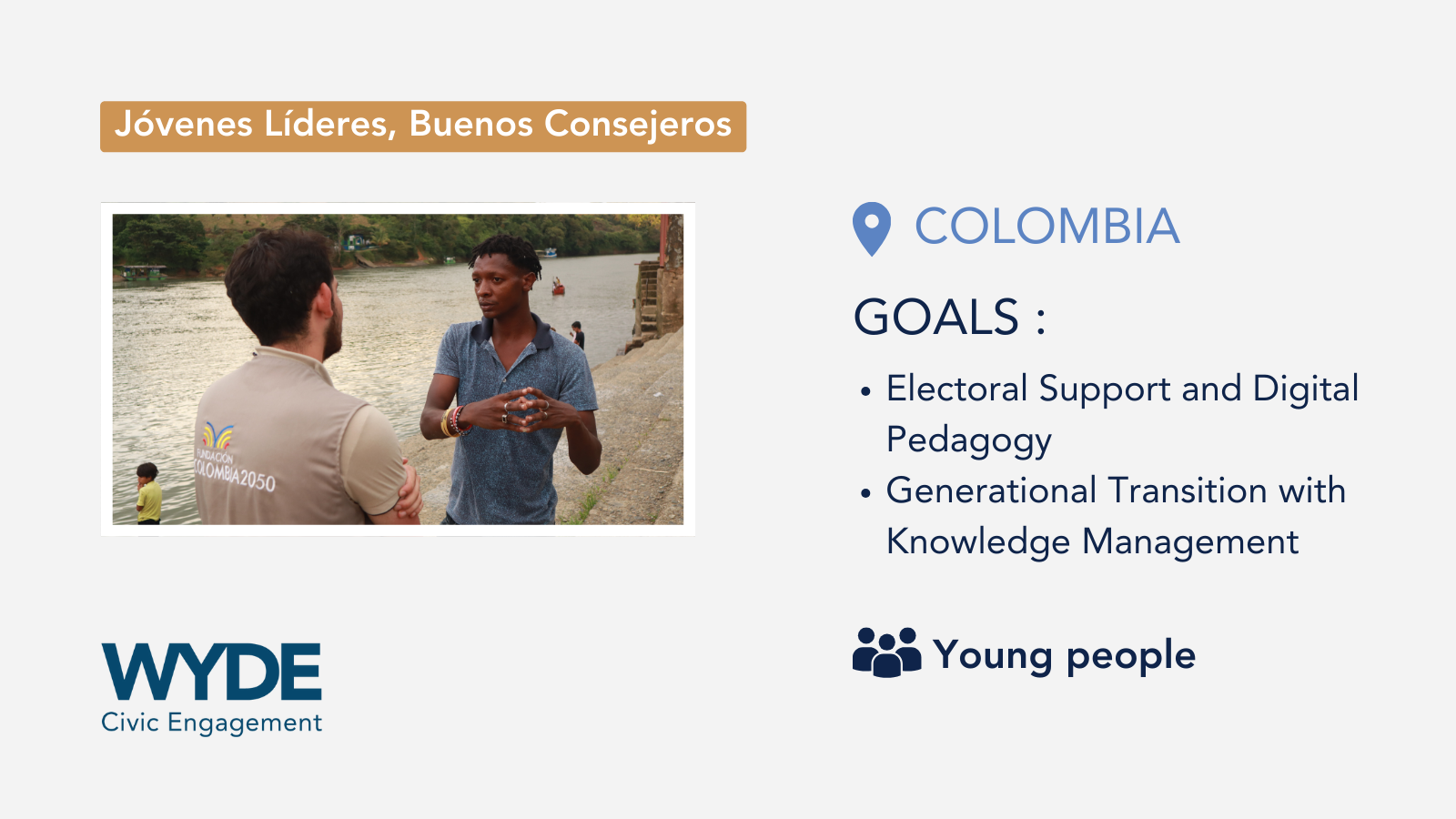
The “Jóvenes Líderes, Buenos Consejeros” project aims to address these challenges through three main activities:
- Training: Educational processes targeting young aspirants and public institutions to strengthen the capacities for the effective role of councilors and their relationship with local governments.
- Electoral Support and Digital Pedagogy: Enhancement of the Candidateados platform, which will host lists and programs of aspirants in each municipality and district. This tool will be complemented with pedagogical content and graphic resources to promote informed voting and improve the connection between voters and candidates.
- Generational Transition with Knowledge Management: A strategy for transition between outgoing and incoming Youth Councils, guided by a methodological manual and supported by the central team to facilitate the technical transfer of plans, regulations, experiences, and key learnings.
Expected Impact
The project aims to strengthen Youth Municipal and Local Councils in Colombia by promoting informed voting and addressing knowledge gaps that hinder youth political participation. It seeks to empower youth leaders to effectively influence their communities through a structured understanding of their roles and representation tools. Key strategies include:
- A virtual pedagogy strategy to educate young candidates, voters, and councilors on viable proposals, the Youth Citizenship Statute, and ethical campaigning.
- Enhancing the Candidateados web platform to provide detailed information on youth electoral processes nationwide, supported by digital resources tailored to various contexts.
- Developing a methodological manual to guide transitions between generations of youth councilors, ensuring continuity in planning, normative transfer, and experience sharing.
About Fundacion Colombia
Fundación Colombia 2050 was launched as an initiative by a group of Colombians to strengthen democracy and promote citizen participation and collective leadership. The organization focuses on projects that foster a culture of peace, transparency, and the fight against corruption, with a special emphasis on youth involvement.