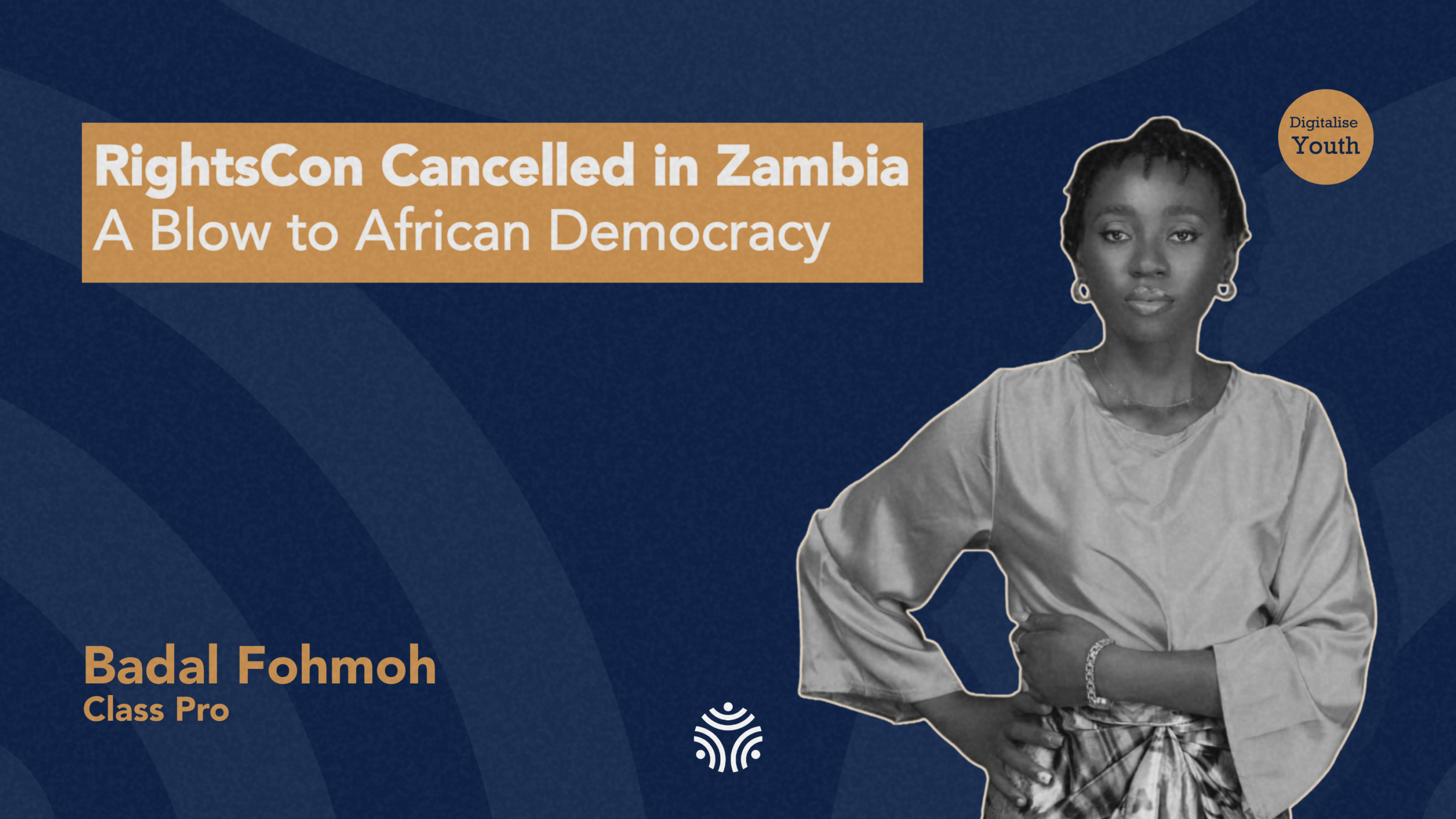
The Zambian government has postponed RightsCon 2026. It’s possible to cancel a summit, but one conviction remains. For many, it’s a setback. For democracy, and for me, it’s much more than that. .
I had prepared for this trip the way one prepares for the arrival of a baby. The logistical details, the words I was going to say, the meetings I was going to have, the content I had planned, the outfits. Everything was thought out, anticipated and expected. And as with a baby, you never really prepare for it not to happen.
The trip I won’t make
I should have been in Lusaka on May 8. Not just for RightsCon. Not just for the sessions, the panels, the meetings with activists from all over the world. I should have been in Lusaka on May 8 because it’s my birthday. My 30th birthday.
I had imagined it all. Blowing out my candles in an African city I’d never set foot in before. Bringing a Cameroonian voice, a pan-African voice, to the world’s largest summit on human rights in the digital age, for the 14th edition of RightsCon. And to return to Douala on May 9, a head full of encounters, ideas and energy.
On April 28, everything collapsed in a single announcement.
But that’s not all. To be in Lusaka, I had given up another invitation, that of the French Embassy in Cameroon for the Africa Forward Summit. A conscious choice, consistent with my commitments. Today, RightsCon has been cancelled, and it’s too late to rejoin the Africa Forward Summit. I find myself without one or the other, a double blow the direct consequence of a decision taken without consultation, without notice, without regard for the thousands of people mobilised.
RightsCon, what exactly is it and why does it matter?
RightsCon is more than just an event. It’s the global space where activists, human rights defenders, journalists, researchers, legislators and civil society representatives come together to debate on the future of the digital age. This 14th edition was to welcome over 2,600 in-person and 1,100 online participants, representing over 150 countries and 750 institutions.
For me, this trip had an extra dimension. As a member of the Global Board of Directors of the UNESCO MIL Alliance, representing the African continent, I was also due to take part on May 5 in the workshop to validate the African framework on Media and Information Literacy, organised jointly by UNESCO and the African Union, to coincide with World Press Freedom Day. A historic moment for the continent, to which I would have contributed in my own right.
Holding RightsCon in Zambia was also a powerful symbolic act. In 2023, Access Now had pledged to bring the summit back to the African continent. Choosing Lusaka recognised the strength, resilience and global importance of the African digital rights community. It was a way of telling us: your voices matter. Your struggles have a place here.
Behind Zambia’s cancellation, the hand of Beijing
The Zambian government’s official version speaks of “national values” and “disclosure of crucial information”. A vague, bureaucratic formula that doesn’t get to the heart of the matter.
The bottom line, Access Now made clear in its official statement: it was foreign interference that killed RightsCon 2026. On April 27, just one day after a government statement officially endorsed the event, diplomats from the People’s Republic of China put pressure on the Zambian government. The reason: representatives of Taiwanese civil society were due to attend the summit.
The informal condition for maintaining RightsCon was unambiguous: to censor certain topics and exclude Taiwanese participants in both in-person and online sessions.
Access Now refused. That was their red line.
What happened next resembles a textbook lesson in the mechanisms of transnational repression. Despite a memorandum of understanding signed with the Zambian Ministry of Technology and Science, despite months of transparent cooperation, despite regular meetings at all levels – the decision to cancel was communicated via the state media on April 28 at 9:33pm, a national holiday, without consultation, without prior official notification, without any meetings granted despite repeated requests.
I don’t think it’s clumsiness, I think it’s method.
Collateral damage we can’t see
There’s a lot of talk about 2,600 frustrated participants, cancelled sessions and lost plane tickets. But behind these figures are individual stories that the official press releases don’t tell. Mine is one of them. There are also the local Zambian partners who worked for months alongside Access Now, whose names don’t appear in any headlines, but who have given their all. There are the African activists for whom RightsCon represented a rare opportunity to access an international space. There were the civil society organisations who had built their agenda around these few days in Lusaka.
What Beijing has decided to erase is not just one event. It’s an entire ecosystem of mobilisation, sharing and resistance.
To remain silent would be to betray
I work every day on digital literacy, freedom of expression and citizens’ rights in the online space. I run Class Pro, a pan-African association for media and information literacy. I firmly believe that our online and offline spaces of expression must be defended consistently, methodically and with conviction.
So yes, I’m angry.
Not a sterile anger. Anger that compels me to write, to bear witness, to not let this story dissolve into the flow of current events. What happened in Zambia is not an isolated diplomatic incident; it is the sign of a deep and worrying trend: that of states yielding to pressure from foreign powers to reduce the space for global civil society. Today, Lusaka. Tomorrow, where?
It’s possible to cancel a summit, but one conviction remains.
This May 8th, I won’t be blowing out my candles in Lusaka. But I’ll be standing, here in Douala, continuing to raise my voice, to question, to build.
Because our clicks can become actions. And our voices, levers of transformation.
I’m not making a wish. I will continue.
With all my passion,