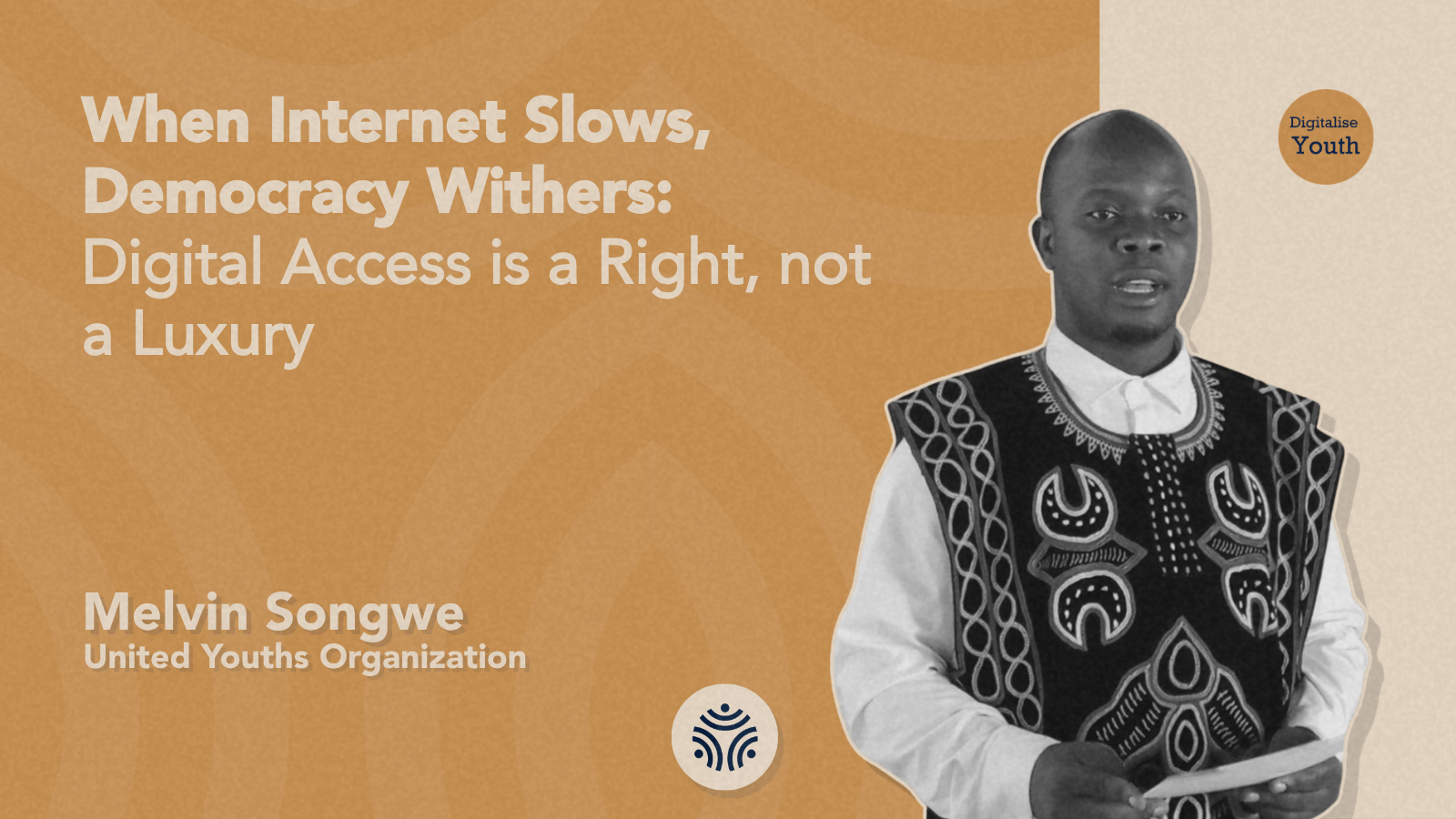
I remember while in Bamenda and some time in 2017, the internet shutdown didn’t just cut our fiber; it severed our lifeline to the world. As our organization was gaining momentum, the digital darkness descended, lasting for months. Then came COVID-19, creating a perfect storm of isolation. While global peers transitioned to virtual classrooms and remote advocacy, we were trapped in a double lockdown – physical and digital. I watched helplessly as hard won international partnerships dissolved and educational milestones slipped away because my IP address was essentially blacklisted by geography and state policy.
Empowering Youth: The Role of Digital Participation
As the Founder of United Youths Organization (UYO) and a youth activist, I’ve seen how Cameroon’s shrinking digital space silences our youth especially with limited internet access and suppression of digital rights hindering meaningful youth participation in democratic processes. The initiative dubbed “Youth Engagement in Democratic Processes in Cameroon”, under the Digitalise Youth project, is our intentional response to reclaim that voice. Operating in crisis-affected regions such as the North West, South West and Far North regions, we have remained focused on bridging the gap between the ruling elite and the youth. A cornerstone of our work is the organisation of an Inclusive National Youth Advocacy Conference during which we drafted a formal advocacy paper to push the government toward digital inclusion. Meanwhile, our #YouthVoiceNaPowa campaign is aimed at promoting digital democracy while countering information disorder that fuels conflict and enhancing online security.
During the advocacy dialogue held in the Far North region, we explored how digital technology will influence change before, during and after the presidential elections. Since then, we witnessed young activists using platforms such as Whatsapp, Telegram and Tiktok to bypass state aligned media and create viral campaigns which targeted millions of voters. This created a transparent digital trail that made traditional electoral fraud significantly harder to conceal. We trained youth on AI-driven fact-checking tools to debunk disinformation and deepfakes and witnessed youth activists making use of these during the presidential elections in 2025. This digital surge turned smartphones into shields of democracy, amplifying voices of young Cameroonians, especially those in the hard-to-reach and crisis regions. Our advocacy at UYO transformed mobile phones into tools for accountability.
Youth Voice: Digital Rights, Heart Beat for Democracy
For me digital rights are the heartbeat of modern Cameroonian democracy. We still carry the scars of 2017, 230-day internet blackout in the Anglophone regions, a period where civic participation was forcibly silenced, and the youth were cut off from the global stage.
While the North West and South West regions were plunged into digital darkness, we didn’t wait for the fiber to be reconnected. Myself, together with some tech youth, built a localized mesh network using repurposed routers in a hidden basement in Bamenda. We transformed victims of the shutdown into human servers, we didn’t just talk about rights; we engineered a way to exercise them when the state tried to delete us. We proved that even in total darkness, you can’t switch off a community that’s determined to be heard.
We must mobilize the next generation and move beyond traditional activism into a more resilient, narrative-driven strategy. Freedom cannot be leased from a provider; the power must shift from the kill switch to the community to ensure the signal survives the silence. By treating youth as the operating system of the movement rather than just a target audience, we created a distributed leadership model that adapts faster than any censorship system.
Advocacy for Digital Governance
To ignite a true digital revolution, the government must bridge the chasm carved by crises in the North West, South West, Far North, and East regions. First, connectivity must be treated as a peace-building tool, decision-makers must pledge an absolute end to internet shutdowns in conflict zones, recognizing that the web is a lifeline for education and humanitarian aid, not a security threat. We need digital sanctuary innovation hubs specifically designed for displaced youth and young women, ensuring that those fleeing violence are not also exiled from the global economy.
Furthermore, Cameroon must reform restrictive cyber laws that often target young activists, replacing surveillance with safety. By establishing a National Youth Digital Council that mandates representation from all ten regions, the government can transform youth from passive users into architects of policy. Africa’s heartbeat is its youth, yet a digital divide threatens to silence this vibrant pulse. To unlock the continent’s potential, leaders must treat internet access as a fundamental right rather than a luxury, slashing data costs and expanding infrastructure to the furthest rural reaches. However, we need robust, harmonized data privacy frameworks that shield young creators from surveillance and arbitrary internet shutdowns. Crucially, stop building policies for youth and start co-creating them with youth. Establish regional Digital Youth Assemblies where young activists sit at the decision-making table, shaping the algorithms and laws that govern their lives.
By fostering digital literacy, leaders can transform Africa from a consumer of technology into a global powerhouse of innovation. The future of African democracy isn’t just on the ballot; it’s in the code, the cloud, and the courageous voices of its youngest citizens.
Melvin SONGWE SHUYE, United Youths Organization, Cameroon
