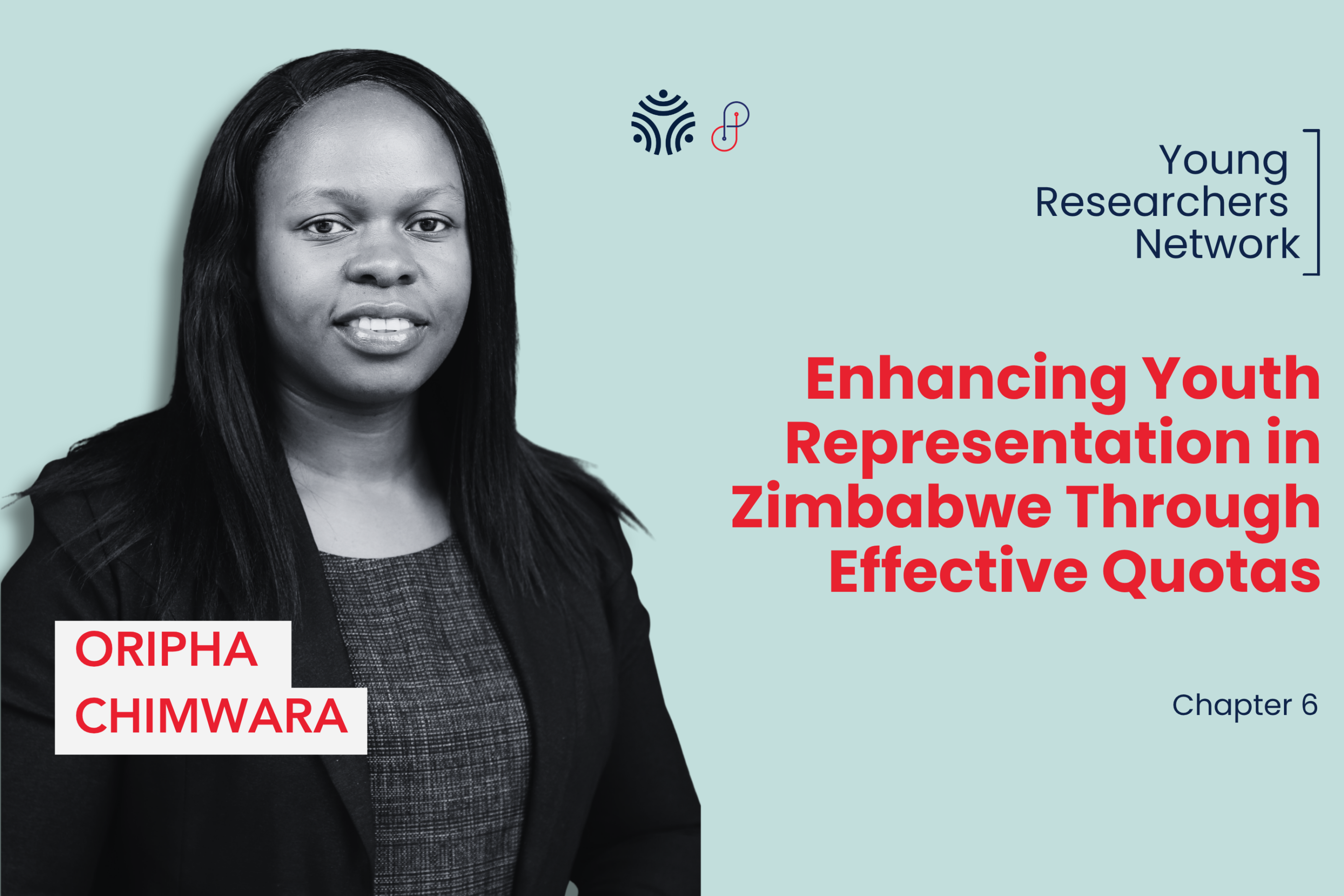
Enhancing Youth Representation in Zimbabwe Through Effective Quotas
Across the globe, quotas have been used to promote the inclusion of underrepresented social groups. Indeed, the introduction of such provisions in politics is widely regarded as a legitimate way of ensuring equal opportunities.[i]Previously, representational politics centred on gender quotas; recently, the focus has shifted to youth quotas.
Reports by the Inter-Parliamentary Union highlight that about half of the global population is aged under 30, yet young people are underrepresented in national parliaments: in 2023, only 2.8% of the world’s parliamentarians were under 30, while 18.8% were under 40.[ii] This lack of youth representation diminishes institutional credibility, intensifies young people’s feelings of powerlessness, and prevents parliaments from effectively addressing the critical issues that affect this social group.[iii]
But while youth quotas appear to be desirable political tools, there is no consensus on their impact on representation. Beyond their potential benefits, the novelty of quotas and the broader political and institutional framework in which they are implemented also play fundamental roles in shaping youth inclusion.[iv] Thus, youth quotas, although progressive, are “merely one aspect of the more important project of ‘democratising democracy’”.[v]
Zimbabwe introduced a youth quota system in 2021. This chapter examines the conditions under which quotas contribute to the equal and fair representation of young people in the country’s parliament. Specifically, the study explores to what extent Zimbabwe’s quota system is accompanied by an ecosystem of institutions, laws, and programmes that promote youth participation in the legislature. The findings will help inform policy in countries such as Zimbabwe that are new to the use of youth quotas.

Dr Oripha Chimwara is a political scientist and author whose work focuses on natural resource governance, women, and youth participation, advocating for inclusive decision-making and democratic accountability.
Methodology
This study employed a qualitative methodology to examine the influence of Zimbabwe’s youth quota on promoting youth inclusion in parliament. The research was carried out as part of the author’s PhD study on youth participation and representation in Zimbabwe. Interviews were conducted with parliamentary officials, four young parliamentarians, and six youth activists.
The parliamentarians and activists were selected according to strict criteria. The former were members of the Zimbabwean parliament that was formed after the 2023 general elections; they were all aged between 18 and 35 at the time of their election. The latter were members of the same age group who were working either independently or under a registered civil society organisation. The criteria of sex, education level, and party affiliation were not used either to include or to exclude participants.
The study also drew on primary and secondary source documents to place the findings in a broader national and international context. Documents consulted included journal articles, election observation reports, civil society organisation reports, and media reporting, such as press releases and newspaper articles.
This approach, based on multiple qualitative methods, ensured corroboration of the findings. Research participants were assured of anonymity through the removal of all identifiers and the use of codification.
Introduction of a youth quota in Zimbabwe
The paradox of elections is that they can be used to promote or undermine democratic governance.[vi] Having now held several elections since gaining independence in 1980, Zimbabwe has a political landscape marked by feelings of apathy, despair, and resignation among a significant number of young people.[vii]
The issue of youth representation in Zimbabwe’s national parliament is a relatively recent phenomenon, although a women’s quota has existed since 2013. Calls for greater youth inclusion in parliament have come from both local and international organisations. In 2019, the Youth Empowerment and Transformation Trust (YETT) called for 50% youth quotas for political parties, parliament, and government to ensure young people’s effective representation and participation in democratic processes.[viii] A 2018 report by the Zimbabwe Election Support Network highlighted the need to involve young candidates in decision-making.[ix]
Similar views were expressed during a 2018 conference led by the Mandela Institute for Development Studies titled “Reigniting Hope for Democracy beyond Elections in Zimbabwe”. Participants argued that because young people constitute a majority of citizens in Zimbabwe, this should be reflected in the make-up of leadership positions, including in parliament. International election observers, such as the Commonwealth, also urged Zimbabwe to consider a youth quota system similar to those of other countries, like Rwanda.
In response to these calls, a constitutional amendment in 2021 introduced a youth quota system in Zimbabwe for the first time. The system reserves 10 out of 280 seats in the National Assembly – the lower house of the national parliament – for members aged between 21 and 35, one from each of the country’s 10 provinces. They are elected by party-list proportional representation.[x] This system was first used in the 2023 general elections.
Zimbabwe’s youth quota of just under 4% is comparable with that of the four other countries that have a similar system: Uganda (1.2%), Rwanda (1.8%), Kenya (3.4%), and Morocco (7.6%).[xi]
Impact of the youth quota
Zimbabwe’s introduction of a youth quota system has had far-reaching implications for representational politics in the country and for the structure of parliament, in addition to providing a foundation from which to improve Zimbabwean democracy. Indeed, the quota system is the most significant advance in youth representation in Zimbabwe’s current parliament. The Commonwealth’s 2023 election observation mission commended the establishment of the youth quota.[xii]
Four research participants interviewed for this study expressed their support for the quota, calling it a “positive beginning” for youth representation in parliament. They argued that the quota creates an open political environment for young people to attain leadership roles. These roles are often difficult to reach through traditional party pathways because of prevailing cultural factors, which place the elderly in sacrosanct positions.[xiii] In the words of one study, young Zimbabweans have to navigate “gerontocratic masculinities”.[xiv]
Supporting the youth quota, one young parliamentarian from the main opposition party argued that “the youth quota is a progressive measure which should be applauded as it shows that the Zimbabwean government is pushing towards the best international practices on ensuring youth [can] participate in decision-making institutions”.[xv]
The youth quota has also increased the number of young people who stand as candidates in elections. This confirms earlier research that found that the youth quota has promoted young people’s candidacies.[xvi] Interviewees highlighted that “for the first time, many youths were not afraid to stand as candidates”. Others argued that the quota’s significance lies in the fact that it serves as an “initiation process” for young people into decision-making.
As a result of the youth quota, Zimbabwe’s 2023 elections saw an increase in the number of young people in parliament for the first time since 1980. A total of 35 young people were elected;[xvii] in addition to the 10 under the youth quota, this figure includes eight parliamentarians who were elected through a separate quota for women and 17 who were elected directly under no quota. Thus, youth representation in the 2023 parliament stood at 12%, an increase from 2% in the previous legislature.[xviii]
Comparing Zimbabwe with its neighbours reveals a positive link between the presence of a youth quota and the level of youth representation. In the European Partnership for Democracy’s 2025 Global Youth Participation Index (GYPI), Zimbabwe achieved a score of 13 out of 100 for youth representation in the legislature, significantly higher than Mozambique’s 3 out of 100, Zambia’s 2 out of 100, and Botswana’s 0 out of 100 – all countries that lack youth quotas.[xix] In contrast, South Africa, which also does not have a quota, scored 14 out of 100.[xx] These scores illustrate that while a quota can enhance youth representation in the legislature, other factors, including the quality of political rights, are also crucial. On this dimension, South Africa performed well, scoring 86 out of 100, compared with Zimbabwe’s 28 out of 100.[xxi]
Zimbabwe’s introduction of a youth quota system – combined with the existing quota system for women, which was extended by a constitutional amendment in 2021 – broadened the avenues for young people to be elected. Still, while young women had more options for getting elected than their male counterparts, they remain underrepresented in parliament. Of the 10 seats reserved for young people, only three are occupied by women.[xxii] Meanwhile, only one of the 17 young parliamentarians who entered the legislature by direct election is a woman. Eight young women from the ruling ZANU-PF party were elected under the women’s quota.
Despite the positive outcome of the youth quota, concerns have been raised about its implementation. The 2019 YETT report questioned the extent to which the dynamics of political engagement in Zimbabwe could be effectively addressed through the country’s party-list system.[xxiii] There has also been criticism of the limited number of seats reserved for young people. This view was supported by nearly 80% of the study participants.
Indeed, establishing a quota of 10 youth seats highlights the imbalance in parliamentary representation in a country where young people make up the majority of the adult population.[xxiv] The quota system should therefore be viewed as one element of a broader democratic project aimed at promoting youth representation in parliament. Zimbabwe’s wider institutional and political framework needs to be structured in a way that reflects the ethos of the representation agenda.
Overall, Zimbabwe’s first experience of a youth quota system has been somewhat beneficial, yet its impact on long-term democratic growth is unclear. On the one hand, by ensuring a minimum number of young people in the legislature, the quota has allowed for some youth representation. On the other hand, the quota alone is not what drives young Zimbabweans’ political involvement, as it allocates only 10 reserved seats, whereas 17 young people were directly elected to the current parliament with no quota. This underscores that meaningful youth representation depends on favourable political conditions more broadly.
The quota therefore risks serving as a ceiling rather than a floor: it suggests that as long as the 10 designated seats are occupied, the issue of youth engagement has been sufficiently addressed. Thus, rather than encouraging and promoting young candidates across all constituencies, the quota may in fact limit the growth of youth representation by standardising a fixed, limited number of young parliamentarians.
This dynamic raises concerns about the potential of quotas to deepen democracy in Zimbabwe. By highlighting the youth presence in parliament, the regime can project an image of inclusiveness without tackling fundamental reforms to liberalise the country’s broader political environment.
Challenges to youth representation in Zimbabwe
The issue of youth representation in Zimbabwe’s parliament should not be viewed solely through the lens of quotas. The democratic task of ensuring youth participation should also focus on the broader political and institutional environment in which the quota system is implemented. An analysis of the 2023 elections, when the quota was first used, reveals that several structural, economic, and political factors hindered young people’s participation and their subsequent uptake of leadership positions.
Young Zimbabweans faced various administrative challenges during the elections that affected their ability to register to vote and stand as candidates. For example, some young people had to pay an additional US$2 for travel to registration centres that were not well located.[xxv]
Another administrative challenge was the exorbitant fees required to register as a parliamentary or presidential candidate. A 2022 law had increased the nomination fee for a constituency election from US$50 to US$1,000.[xxvi] This 1,900% increase made Zimbabwe the country with the highest nomination fees in the region.[xxvii] Such fees disadvantaged potential young candidates.[xxviii]
Election campaigns further increase the cost of politics for young people. A 2001 act provides state funding for parties that received at least 5% of the vote in the previous general elections.[xxix] In 2023, a total of Z$1.5 billion was disbursed to qualifying political parties, with ZANU-PF receiving just over Z$1 billion and the remaining Z$450 million being given to the Movement for Democratic Change (MDC) Alliance.[xxx]
The significance of state funding for political parties when it comes to youth participation is twofold. First, because only qualifying parties receive this funding, parties are instrumental in financing campaigns. Campaign costs are high for individuals, especially young people who decide to run as independent candidates or come from minor parties that do not get state funding.
Second, resource disparities between ZANU-PF and the MDC Alliance unevenly affect the relative chances of these parties’ candidates. Worse, reports indicate that in the 2023 elections, ZANU-PF used many state resources for its campaign, the costs of which were covered by the party directly.[xxxi] Meanwhile, the MDC Alliance had limited resources, and the party’s individual candidates bore their own campaign costs.[xxxii] Party alignment thus influences the cost of politics for young Zimbabweans.
The cost of politics in Zimbabwe is also high because of clientelism. A clientelist party provides material benefits to its supporters in exchange for their votes.[xxxiii] Such parties are commonly observed in countries with high levels of poverty; the benefits offered include branded clothing, food, and other forms of assistance. Clientelism implies that during election periods, the electorate expects aspiring candidates to provide such inducements. Elections are thus a give-and-take, which some young people use to their advantage. But clientelism is a double-edged sword, aspiring young candidates may lack the material benefits to reward their supporters.
Interviewees agreed that Zimbabwe’s electoral politics is characterised by what is known as the “politics of the belly”. This practice refers to the material items, in particular food, that the electorate expects from political parties and candidates. In Zimbabwe, the politics of the belly thrives among young people, many [BY1] of whom are unemployed.[xxxiv] Thus, rather than aspiring to stand as candidates, some young people opportunistically take on marginal roles during elections, such as serving as foot soldiers in exchange for material benefits. In the words of a 2024 study, young people’s “vulnerability to unemployment and lack of resources force them to participate in politics in peripheral roles that allow them to survive through benefits extended to them by patronage systems”.[xxxv]
Gatekeeping by political-party leaderships is another challenge that affects young people who seek political office outside the quota system. In particular, the main opposition party employed a controversial method of selecting candidates called bereka mwana, in which supporters form a queue behind their preferred candidate.[xxxvi] Three-fifths of the research participants agreed that political parties did not prioritise young candidates. In particular, one young parliamentarian argued that the candidate selection process was not based on age but was a simple case of winner takes all.
Young Zimbabweans therefore continue to be structurally and politically excluded, and evidence shows that the quota system of reserved seats is far from addressing these issues. Structural reforms and an accountable, inclusive governance system are needed to ensure sustained youth representation in the country’s legislature.
Conclusions and recommendations
Youth quotas are an essential tool for encouraging youth representation in national parliaments. Zimbabwe has joined four other countries – Rwanda, Kenya, Morocco, and Uganda – in reserving seats in the legislature for young parliamentarians. While Zimbabwe’s youth quota system is relatively new compared with the more established system of gender quotas, it has already yielded positive results.
This view is validated by GYPI data for Zimbabwe and its neighbours Botswana, Zambia, and Mozambique, which do not have youth quotas. Beyond the reserved seats, Zimbabwe’s youth quota had ripple effects, with more young people standing as candidates in the 2023 elections than in the previous contest. As a result, 17 young people were elected from the country’s 210 constituencies under the normal rules.
Still, beyond the quota’s short-term influence in promoting youth inclusion and representation in parliament, the measure’s sustainability is unclear in the broader context of Zimbabwe’s institutional and political environment. Visible setbacks, including administrative hurdles, nomination fees, gatekeeping by political parties, and an entrenched patronage system, hinder the durability of an open space for youth participation.
To ensure the sustained positive impacts of this representational tool, the quota should be implemented in an environment with youth-friendly administrative guidelines and an open political space. To this end, the following four steps would help ensure sustainable youth representation in Zimbabwe’s parliament.
First, the country’s political parties should either adopt a voluntary candidate quota listing or prioritise young candidates during elections. They should also finance young candidates to promote their effective participation.
Second, the Zimbabwe Electoral Commission should ensure its registration centres are in accessible locations to promote the registration of young voters.
Third, the government should revoke the 2022 law that increased the nomination fees for constituency elections and reduce the exorbitant costs of registering a candidacy.
Finally, the women’s quota must be revised to include some reserved seats for young women.
Zimbabwe’s youth quota system is a welcome and progressive instrument, but it needs to be implemented within an ecosystem of youth-friendly electoral norms. While the quota has offered short-term gains for youth representation, its long-term democratic value depends on whether it forms part of a genuinely open political environment. Sustainable youth representation in Zimbabwe’s parliament requires a political and administrative framework conducive to youth participation throughout the electoral cycle.
This chapter is part of a Deep Dive of Young Researchers who worked on Youth Participation for three years. This deep dive is a global collection of 12 case studies unpacking how young people are reshaping political engagement.
The Young Researchers’ Network is an initiative developed in the framework of the European Democracy Hub and EPD’s Women and Youth in Democracy WYDE Civic Engagement project, supported by the European Union.
[i] Drude Darlerup, “Quotas are changing the history of women”, in “The Implementation of Quotas: African Experiences Quota Report Series”, edited by Julie Ballington, International Institute for Democracy and Electoral Assistance (IDEA), 2004.
[ii] “Youth Participation in National Parliaments: 2023”, Inter-Parliamentary Union, 2023, https://www.ipu.org/resources/publications/reports/2023-10/youth-participation-in-national-parliaments-2023.
[iii] Yvonne Kemper, “Youth Participation in Parliaments and Peace and Security Contribution from the IPU to the Progress Study on Youth, Peace and Security mandated by SC Resolution 2250”, Inter-Parliamentary Union, 2015,
[iv] Kemper, “Youth Participation”.
[v] Andrea Cornwall and Anne Marie Goertz, “Democratizing Democracy: Feminist Perspectives”, Democratization 12, no. 5 (2005): 783–800.
[vi] Gilbert Muruli Khadiagala, Khabele Matlosa, and Victor Shiale, “When Elephants Fight: Preventing and Resolving Election-Related Violence in Africa”, Electoral Institute for the Sustainability of Democracy in Africa, 2010.
[vii] Rose Jaji, “Youth Masculinities in Zimbabwe’s Congested Gerontocratic Political Space”, Africa Development 45, no. 3 (2020): 77–96.
[viii] “Towards a New National Youth Policy for Zimbabwe”, Youth Empowerment and Transformation Trust (YETT), 2019, https://idl-bnc-idrc.dspacedirect.org/items/27d119f0-92f9-4d8c-87e3-c853b3c10119.
[ix] “ZESN Report on the 30 July 2018 Harmonised Elections”, Zimbabwe Election Support Network (ZESN), 2018, https://www.zesn.org.zw/wp-content/uploads/2018/07/ZESN-Preliminary-Statement-on-the-30-July-Harmonised-Elections.pdf.
[x] Constitution of Zimbabwe Amendment (No. 2) Act, 2021 (Act No. 2 of 2021) S 124 (1) (c).
[xi] “Youth participation in national parliaments”, Inter-Parliamentary Union, 2021, https://www.ipu.org/youth2021.
[xii] “Zimbabwe 2023 Final Report”, European Union Election Observation Mission (EUEOM), 2023, https://www.ipex.eu/IPEXL-WEB/download/file/8a8629a88fb836fd018fba27b2b90010/Final+Report+Zimbabwe+2023.pdf.
[xiii] David Adeleke, “The Real Reasons Why Africa’s Young People Vote for Old Men”, Ventures Africa, 2017, http://venturesafrica.com/the-real-reasons-why-africas-youngpeople-vote-for-old-men/.
[xiv] Jaji, “Youth Masculinities”.
[xv] Interviewee no. 2, Harare, March 2025.
[xvi] Fadzai Mutasa and Enock Ndawana, “Youth participation in Zimbabwe’s electoral processes post-2008: Challenges and prospects for peacebuilding”, African Security Review 33, no. 3 (2024): 277–93, https://www.tandfonline.com/doi/full/10.1080/10246029.2024.2377589.
[xvii] Interview data, Parliament of Zimbabwe, 2024.
[xviii] Interview data, Parliament of Zimbabwe, 2024.
[xix] “Global Youth Participation Index”, European Partnership for Democracy (EPD), 2025, https://youthdemocracycohort.com/global-youth-participation-index/.
[xx] “Global Youth”, EPD.
[xxi] “Global Youth”, EPD.
[xxii] “2024 National Youth Day Statement”, ZESN, 2024, https://www.zesn.org.zw/wp-content/uploads/2015/10/2024-National-Youth-Day-Statement-by-ZESN.pdf.
[xxiii] “Towards a New”, YETT.
[xxiv] “Zim Politicians Push for Youth Quota”, Business Times, 24 February 2020, https://businesstimes.co.zw/zim-politicians-push-for-youth-quota/.
[xxv] Lloyd Pswarayi, “Between Rocks and Hard Places – Zimbabwean youth and the challenges of political participation”, Heinrich Böll Stiftung, 22 August 2023, https://za.boell.org/en/2023/08/22/between-rocks-and-hard-places-zimbabwean-youth-and-challenges-political-participation.
[xxvi] “Harmonised Elections Report”, ZESN, 2023, https://www.zesn.org.zw/wp-content/uploads/2015/10/ZESN-2023-Harmonised-Election-Report.pdf.
[xxvii] Linda Mujuru, “Zimbabwe’s 1,900% Increase in Fees to Run for Office Excludes Underrepresented Candidates”, Global Press Journal, 23 August 2023, https://globalpressjournal.com/africa/zimbabwe/zimbabwes-1900-increase-fees-run-office-excludes-underrepresented-candidates/.
[xxviii] “Interim Statement of the Commonwealth Observer Group to the 2023 Zimbabwe Harmonised Elections”, The Commonwealth, 2023, https://thecommonwealth.org/interim-statement-commonwealth-observer-group-2023-zimbabwe-harmonised-elections.
[xxix] “Zimbabwe”, EUEOM.
[xxx] “Disbursement of Money to Registered Political Parties”, General Notice 372, 17 March 2023, https://www.veritaszim.net/node/6222.
[xxxi] “Zimbabwe”, EUEOM.
[xxxii] “Zimbabwe”, EUEOM.
[xxxiii] “Harmonised”, ZESN.
[xxxiv] “Africa’s youth are more educated, less employed and less politically engaged than their elders”, Afrobarometer, 17 November 2023, https://www.afrobarometer.org/articles/africas-youth-are-more-educated-less-employed-and-less-politically-engaged-than-their-elders-afrobarometer-study-shows/.
[xxxv] Mutasa and Ndawana, “Youth participation”.
[xxxvi] Patricia Sibanda, “Candidate selection method haunts CCC”, News Day, 28 September 2024, https://www.newsday.co.zw/thestandard/local/article/200032892/candidate-selection-method-haunts-ccc.