Youth Participation in India’s Legislative Politics
Young policymakers, as youth representatives, are essential for ensuring that young people’s voices, aspirations, demands, and challenges are heard at the highest levels of decision-making. However, research in 2024 revealed that the average age of world leaders from 1945 to 2023 was 57, far above the average age of the global population. The study further indicated that only 2.4% of countries had a leader aged 35 or under.[i]
According to the Inter-Parliamentary Union, less than 3% of the world’s parliamentarians are under the age of 30, which is a matter of great concern. The data suggests that 68% of legislators worldwide are over 45, making the spectrum of youth representation in global parliamentary politics extremely narrow.[ii]
India, as the world’s largest democracy, has a vibrant multiparty parliamentary system with a federal structure.[iii] As of 2024, India had 420 million people officially categorised as “youth” – that is, between 15 and 29 years of age.[iv] India has an emerging young population with tremendous potential to buttress the country’s economic growth and ideational, technological, and scientific advances. Adequate representation of young voices in India’s democratic institutions is therefore crucial. Given the country’s robust democracy, which now has nearly 1 billion voters, youth representation in India’s multilayered legislative structures is a vital marker of the inclusivity of its political institutions.[v]
In this context, this chapter analyses the nature of youth political participation in Indian democracy. The study focuses on the Lok Sabha (the lower house of India’s national parliament) and a selection of Vidhan Sabhas (state legislative assemblies) from five states: West Bengal, Assam, Punjab, Kerala, and Rajasthan. The study investigates youth representation in India’s national and state legislatures and seeks to understand the institutional and procedural hurdles for young Indians seeking to participate in electoral politics.
The chapter is divided into four parts. First, it offers a brief profile of India’s youth population and looks at the evolution of youth representation in the country’s electoral politics in general. Second, it takes a deep dive into youth representation in India’s national parliament and selected state legislative assemblies in the last decade and a half. Third, the study analyses the persistent challenges for greater youth political participation in India, bearing in mind the country’s multidimensional diversity. Finally, the chapter explores possible institutional reforms to ensure more inclusive youth representation in India in future.

Ambar Kumar Ghosh is an Associate Fellow at the Observer Research Foundation and a PhD researcher at Jadavpur University, focusing on democratic institutions, governance, and populist politics in India.
Methodology
This study confines its scope to the last decade and a half, for two reasons. On the one hand, this period coincides with India’s changing demographic dynamics, as the country’s population has, on average, become younger over recent years.[vi] On the other hand, this period covers the tenures of two key national governments: the 2004–14 United Progressive Alliance, led by the Indian National Congress; and the National Democratic Alliance, dominated by the Bharatiya Janata Party and in power since 2014.
In addition to the situation at the national level, the analysis also focuses on youth representation in a selection of India’s state legislative assemblies. Apart from the two major national parties, regional political forces are in government in several Indian states. Including an analysis of state-level politics therefore broadens the scope of the study.
The first part of the analysis uses disaggregated data on India’s national and state legislators along with relevant secondary literature. For the second part, primary data was collected to offer an understanding of the opportunities and challenges of youth political participation. Limited in-depth interviews were conducted with young politicians and political hopefuls, and focus group discussions were held with young political actors, young citizens, and members of the general electorate. Thirty experts, including researchers, journalists, election officials, and academics working on youth politics, were also consulted to gather their insights. A quota sampling method was used to choose the respondents.
This chapter uses both quantitative and qualitative research methods. For the quantitative data on youth representation, a descriptive statistical method is used to graphically represent the data. For the qualitative primary data collected through interviews and focus group discussions, discourse analysis is the method adopted.
Understanding India’s youth
India has a substantial youth population. According to government data, 65% of Indian populace is under the age of 35.[vii] In terms of young people’s geographic distribution, a 2024 survey by People Research on India’s Consumer Economy revealed a roughly 2:1 split between rural and urban areas. Of a total of 420 million young voters, about 20 million (nearly 5%) cast their votes for the first time in 2024.[viii]
It is important to understand Indians’ education profile, as it is a key driver of informed participation in public life. In 2024, around 31% of young Indians were university graduates, about 22% had received higher secondary education, and 13% were matriculates, meaning they had passed the 10th-grade secondary school leaving exam. Roughly 13% had only completed primary schooling, and 3% were recorded as illiterate. Thus, it is clear that young Indians have a relatively strong educational profile.[ix] Notably, India’s southern states have more young people in higher education than other regions.
In terms of young people’s economic participation, the data is more revealing. Nearly 40% of young Indians are earners, collectively contributing some 43% of India’s total disposable household income.[x] As for their financial and digital inclusion, 84% have a registered bank account and 81% have a mobile phone, with a sizeable number of youth people using the internet and online payment interfaces.[xi] Hence, a substantial section of India’s youth population has the educational qualifications and the digital and financial skills that are crucial for informed political participation.
The Indian constitution allows anybody aged 25 or over to stand in direct elections for the Lok Sabha or the state legislative assemblies.[xii] Yet India’s youth population has a low presence in the country’s legislative politics. In the first two and half decades of Indian democracy, the average age of Lok Sabha members of parliament (MPs) was between 46 and 50. Over the years, the parliament has grown older, with the average age of MPs ranging from mid-40s to mid-50s (figure 10.1).[xiii]
Figure 10.1. Average ages of Lok Sabha MPs and India’s population, 1952–2024
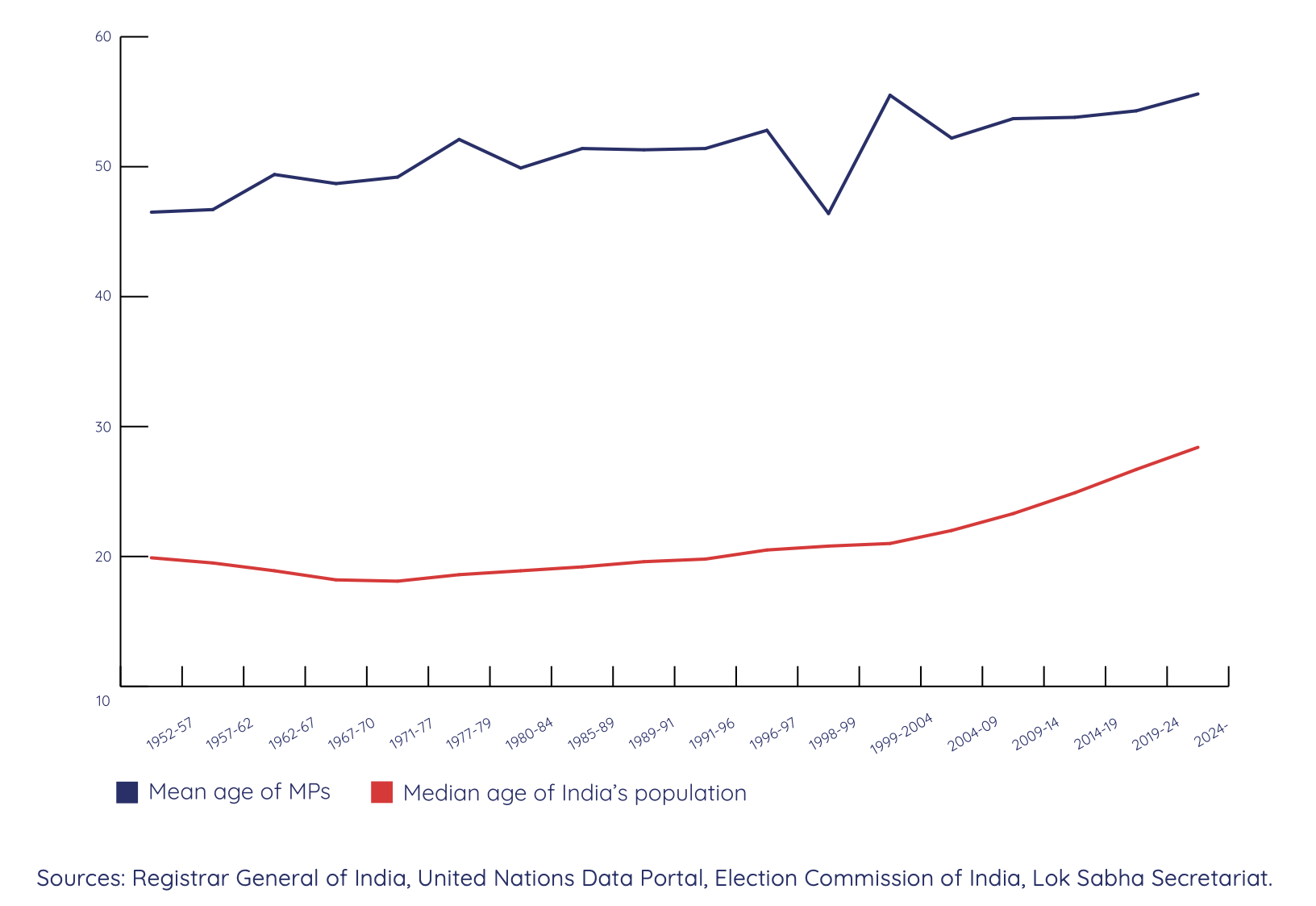
Notably, the percentage of young MPs – those aged from 25 to 40 – in the Lok Sabha has declined over the decades from 30% to 10%. Young people’s levels of turnout on election day have also plummeted in recent years.[xiv]
Youth participation in legislative politics
The share of Lok Sabha MPs aged 25–45 has been low across the last four legislative terms, although the parliaments elected in 2014 and 2024 did slightly better in terms of youth representation (figure 10.2). Over this time, MPs aged 25–35 have never made up more than 3% of the total, while those aged 35–45 have not exceeded 12%. In all of the last four terms, the largest group of MPs has consisted of those aged 55–65, followed by those aged 45–55 and then 65–75. Around 4–8% of all MPs are over 75 years of age. In short, the bulk of MPs in the Indian parliament are aged 45–65, while youth representation is visibly low.
Figure 10.2. Age distribution of Lok Sabha MPs, 2009–24
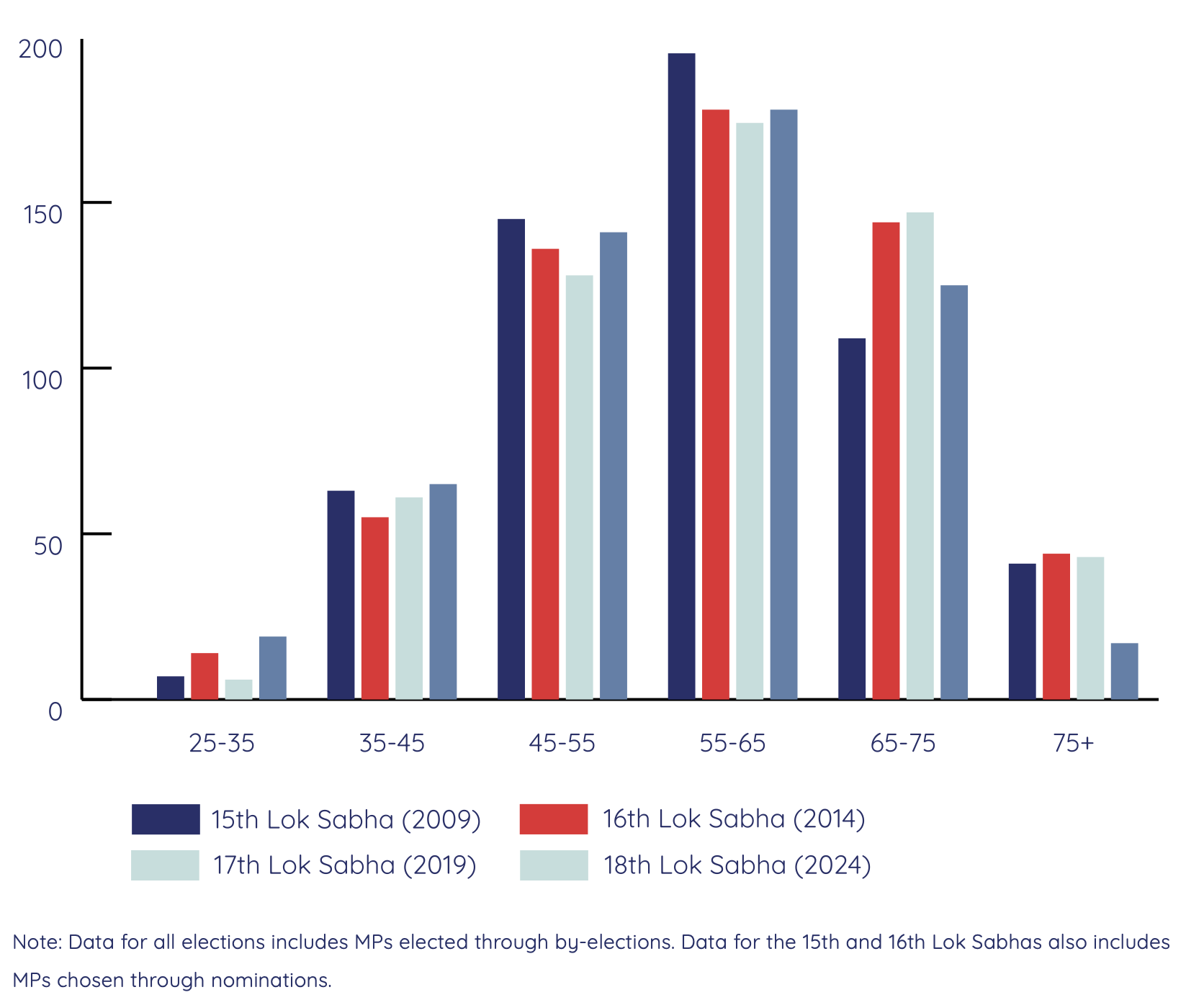
Sources: PRS Legislative, Myneta.info, Election Commission of India.
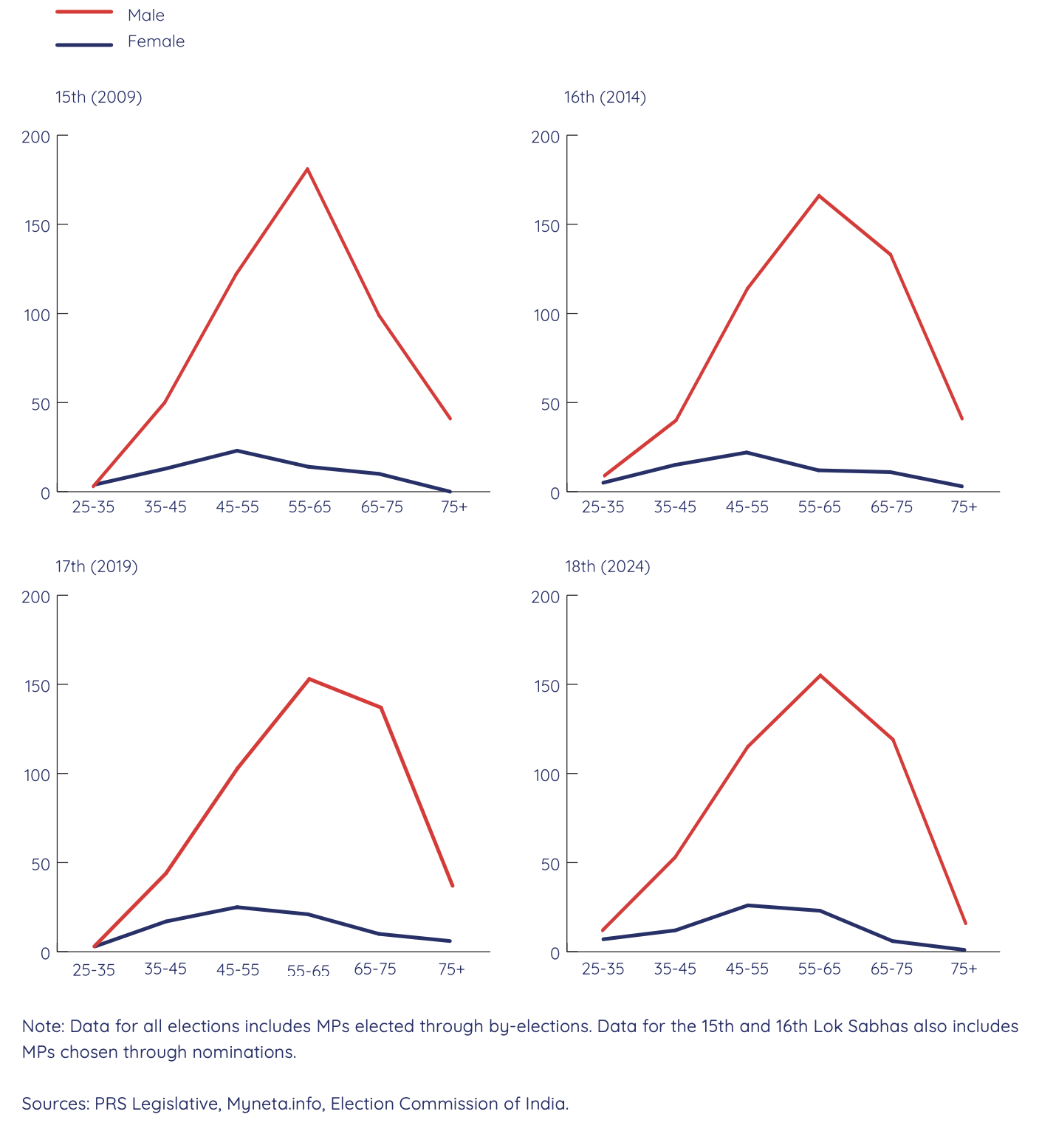
Among India’s young MPs, female parliamentarians are even less well represented than their male counterparts (figure 10.3). Young female politicians appear to face higher barriers to entry into parliament because of social and structural factors discussed below.[xv]
Figure 10.3. Age and gender distribution of Lok Sabha MPs, 2009–24
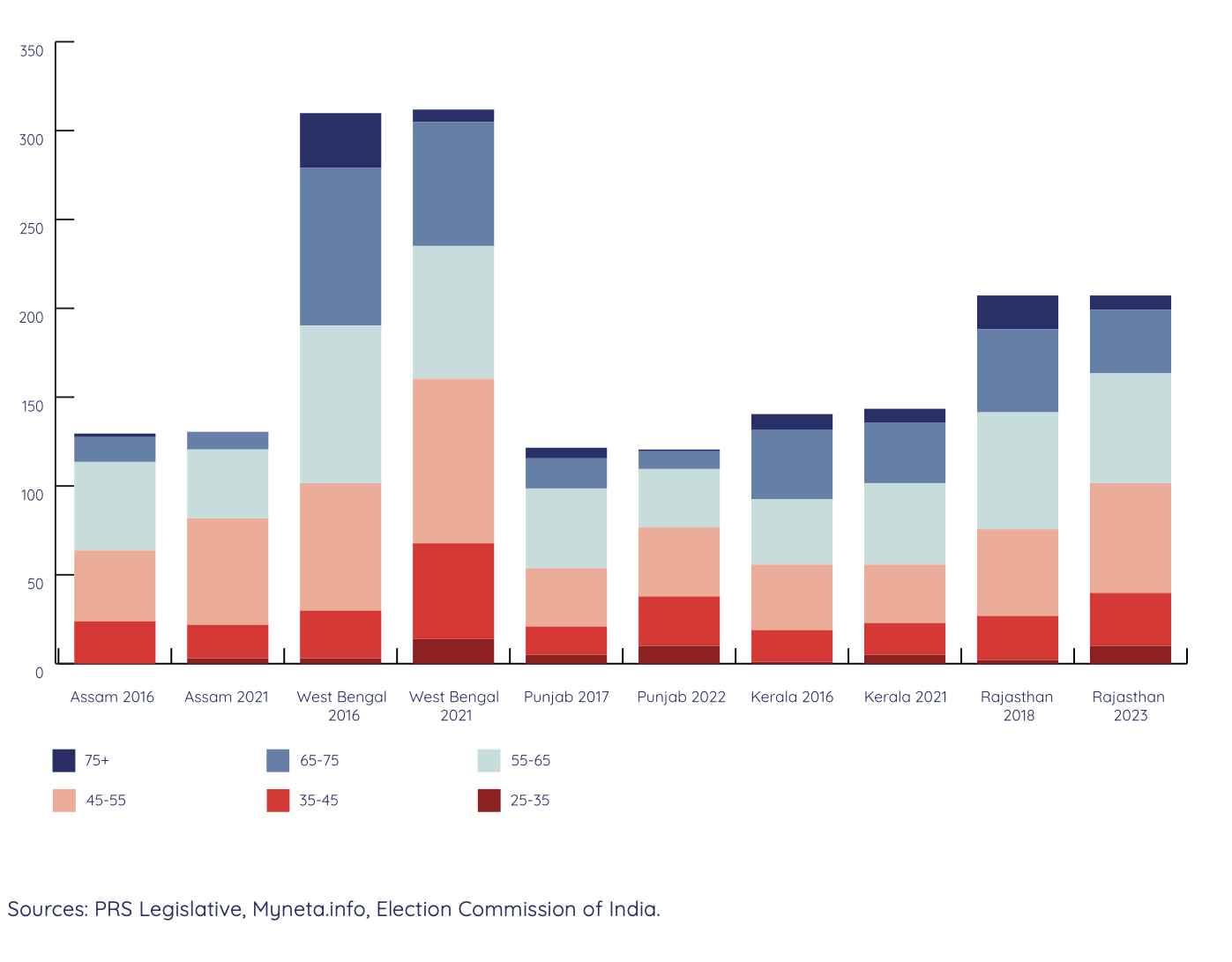
The data further reveals that as in the Lok Sabha, most members of India’s state legislative assemblies (MLAs) are over 45 years of age (figure 10.4). The data is also similarly skewed against young female legislators. However, a few states have slightly higher proportions of MLAs aged 35–45 than do the Lok Sabha and other states. For instance, 17% of MLAs in West Bengal’s 17th legislative assembly were in this age bracket, as were 23% of MLAs in Punjab’s 16th assembly and 18% in Assam’s 14th assembly. Meanwhile, the number of MLAs aged 25–35 is abysmally low for most states.
Figure 10.4. Age distribution of members of selected state legislative assemblies in the last two elections
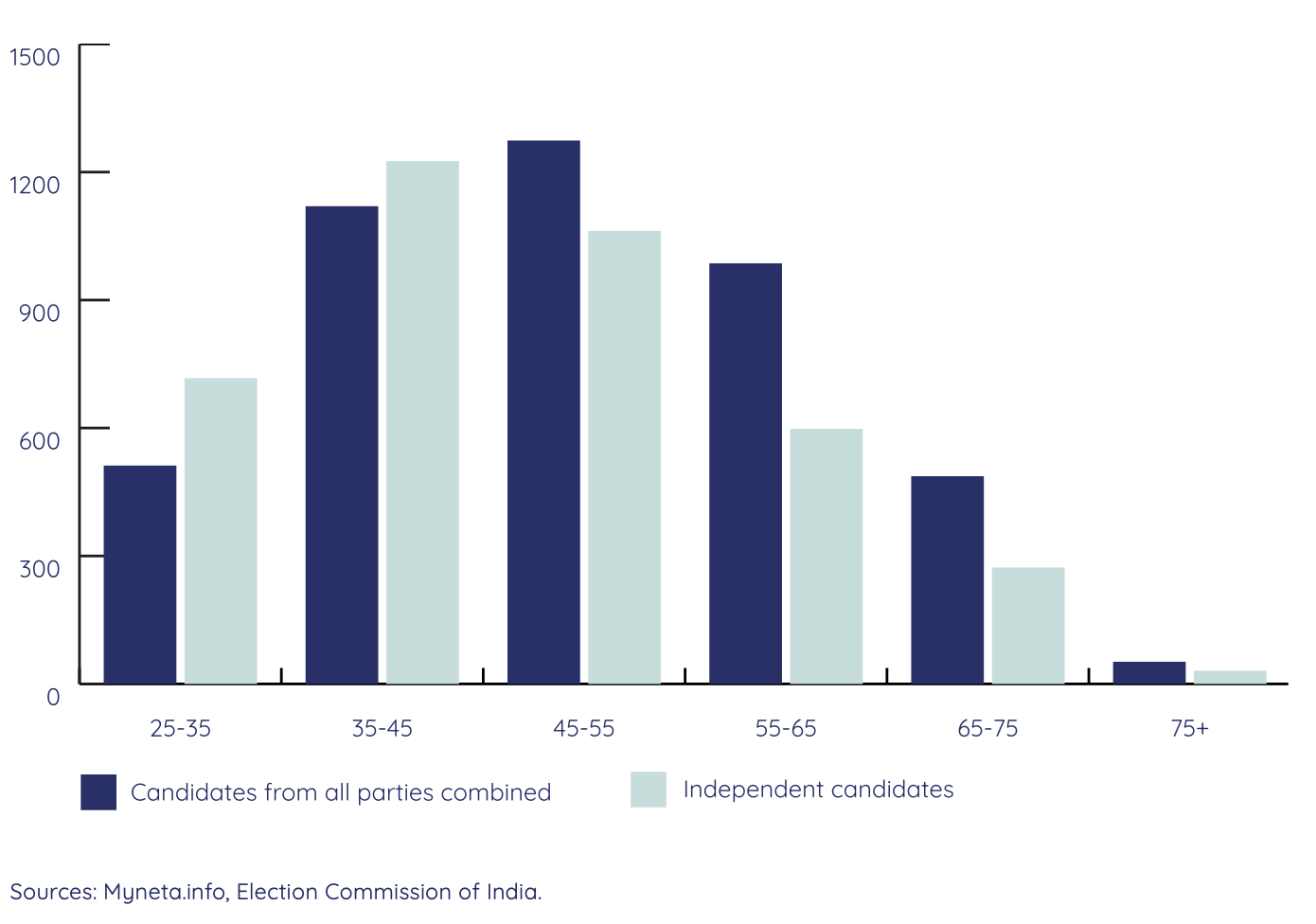
To understand whether young Indians are unable to win elections or are not contesting the elections in the first place, the analysis looked at a breakdown of candidates at the last Lok Sabha election in 2024. The data revealed that political parties in India put forward very limited numbers of young candidates (figure 10.5). Interestingly, a sizeable number of young candidates who do not have the support of an established party stand as independents, but they are often unable to win because of structural limitations, especially a lack of political capital and financial backing.[xvi]
Figure 10.5. Age distribution of Lok Sabha candidates, 2024
The European Partnership for Democracy’s 2025 Global Youth Participation Index confirms a low level of youth participation in electoral politics not only in India but also in many other countries. The report attributes this low participation to structural and logistical barriers rather than to political apathy among young people.[xvii]
Barriers to youth participation
Interviews and focus group discussions revealed five key challenges that young people in India face in participating in electoral politics: the role of money, centralised party structures, disillusionment with politics, dynasticism, and greater hurdles for women. These institutional, structural, procedural, and socioeconomic factors cumulatively hinder young people’s involvement in India’s political life.
The growing salience of money
The exponentially rising costs of a career in electoral politics are deterring many young Indians from entering politics.[xviii] Many interviewees admitted that the increasing costs involved in building political networks, gaining party nominations, taking up mass-mobilisation initiatives, running election campaigns, managing polling stations on election day, and securing social media outreach made it extremely difficult to effectively fight and win elections.
According to the study participants, legacy candidates and privileged veteran politicians with adequate social capital overshadow younger and poorer candidates. Less well privileged but committed young political hopefuls reported that the rising costs of electoral politics were a “major discouragement for them to continue in politics”.[xix]
Centralised party structures
India’s major political parties tend to nominate very limited numbers of young candidates because of the parties’ highly centralised structures.[xx] The dominance of veteran politicians and party leaderships, on the one hand, and parties’ concerns about the electability of new and younger candidates, on the other, act as major impediments to bringing young people into electoral politics. Many young, vibrant, ambitious, articulate, and committed individuals are therefore unable to secure their party’s nomination to contest an election.
As a result, many young aspiring parliamentarians are compelled to stand as independent candidates. However, because they lack resources and political capital, few independents win elections. Many of these young, driven politicians are then deterred from contesting the next election as they reel from “financial distress and lack of motivation”.[xxi]
Negative perspectives of political careers
A crucial finding of this study is that many young people are disillusioned with politics and sceptical of embracing it as a career. They feel demotivated and discouraged by a strong societal perception that politics is an “immoral, corrupt, unstable, and violent career”.[xxii] Many young individuals who are driven and want to serve their nation and society are apprehensive about devoting their life to electoral politics, which is perceived to be marred by violence, defamation, and financial risk. Several young political hopefuls interviewed for this study lamented that despite their willingness to contribute to India’s nation-building, they have stayed out of politics because of their own inhibitions and those of their families about a career in politics.
The prevalence of dynastic politics
The strength of dynastic politics in India has enabled many young members of famous families to successfully enter and thrive in electoral politics, as they have the necessary resources and privilege to do so. Meanwhile, many less well privileged would-be contenders feel that this situation hinders their participation in electoral politics.
Many interviewees confided that the prevalence of dynastic politics and the dominance of legacy candidates kept “non-dynastic and under-privileged youth” away from electoral politics.[xxiii] While young people with strong political family connections or some other financial or social legacy that gives them access to political leaders can easily receive party nominations through their networks, those who are not privileged in this way are neglected and kept outside the electoral competition.
Greater hurdles for female politicians
Finally, a notable number of young female interviewees who wanted to enter politics revealed that they experienced perceptible discrimination. As non-privileged young women, they face a harder struggle than their male counterparts to secure a party ticket or access the financial and social capital needed to contest and win expensive elections. What is more, fear of violence, humiliation, social prejudice, and structural barriers in political life deter many talented and committed young women from taking part in India’s electoral politics.[xxiv]
Recommendations
Based on the views of various stakeholders and experts consulted for this chapter, and drawing on insights from other related studies, this section offers some recommendations for how to increase youth participation in India’s parliamentary politics.[xxv]
Youth quotas in party nominations
Political parties should have a legally enforceable mechanism to reserve at least one-third of all nominations for candidates under the age of 45. Sub-quotas would ensure that this allocation goes to the socially and economically marginalised.
Limits on money and muscle
Effective legal measures and stringent safeguards by the Election Commission of India are essential to reduce the growing salience of money and the role of antisocial behaviour and violence in politics. This would encourage young, non-privileged, but interested political hopefuls to enter electoral politics.
Greater public awareness
Political actors and other stakeholders should launch awareness campaigns to educate voters about the importance of having more young leaders in politics. These campaigns should encourage young people to become more politically aware and take an active part in political life without fear or hesitation.
A special emphasis on bringing more young women into politics
Young female politicians and aspiring candidates find it particularly difficult to enter electoral politics. As such, structural reforms and societal transformation are needed to make India’s electoral politics more inclusive by giving young and committed women from non-privileged backgrounds a strong voice.
Conclusion
It is crucial to engage India’s young people in the country’s electoral politics in general and its legislative structures in particular. Under India’s system of parliamentary democracy, youth representation in the national legislature has a direct bearing on the presence of young leaders in the executive branch and the institutions of government. India has a large young population, so appropriate representation of youth voices in the country’s politics is a prerequisite not only for India’s advancement and well-being but also to ensure more responsive, inclusive, and democratic institutional structures.
Most importantly, young people have an inalienable democratic right to be represented in the institutions of democracy. Effective measures are therefore crucial to mitigate the institutional and procedural barriers to greater youth representation in India’s legislative politics.
This chapter is part of a Deep Dive of Young Researchers who worked on Youth Participation for three years. This deep dive is a global collection of 12 case studies unpacking how young people are reshaping political engagement.
The Young Researchers’ Network is an initiative developed in the framework of the European Democracy Hub and EPD’s Women and Youth in Democracy WYDE Civic Engagement project, supported by the European Union.
[i] Daniel Stockemer and Kamila Kolodzieczyk, “The Age of World Leaders: A Comprehensive Discussion”, Sociology Compass 19, no. 5 (2024), https://doi.org/10.1111/soc4.70074.
[ii] “Data on Age: Global and Regional Averages”, Inter-Parliamentary Union, https://data.ipu.org/age-brackets-aggregate/.
[iii] Ramachandra Guha, India After Gandhi (HarperCollins, 2007).
[iv] Rajesh Shukla, “India’s Young Harbour Big Plans”, People’s Research on India’s Consumer Economy, 4 May 2024, https://www.price360.in/articlesdetails.php?url=indias-young-harbour-big-plans.
[v] “India Election 2024: The World’s Largest Democracy Votes”, Institute of Development Studies, 16 May 2024, https://www.ids.ac.uk/news/india-election-2024-the-worlds-largest-democracy-votes/.
[vi] David Born, “India’s Economic Success Factors and the Social and Cultural Challenges for Further Progress”, Roland Berger, 20 January 2025, https://www.rolandberger.com/en/Insights/Publications/India-s-remarkable-economic-ascent-A-distinct-story-of-growth.html.
[vii] “India’s Growing Focus on Youth and Sports”, Press Information Bureau, Government of India, 1 February 2025, https://www.pib.gov.in/FactsheetDetails.aspx?Id=149107.
[viii] Shukla, “India’s Young”.
[ix] Shukla, “India’s Young”.
[x] Shukla, “India’s Young”.
[xi] Press Trust of India, “Over 82% of Rural Youth Able to Use Internet in India, Says Govt Survey”, Business Standard, 9 October 2024, https://www.business-standard.com/india-news/over-82-of-rural-youth-able-to-use-internet-in-india-says-govt-survey-124100901062_1.html.
[xii] Pankaj Kumar Patel and T.V. Sekher, “Young India, Ageing Parliament”, Economic and Political Weekly IIX, no. 31 (2024).
[xiii] Pankaj Kumar Patel, “Navigating Challenges and Opportunities: Youth Representation in the Indian Parliament”, Research Gate, May 2025, https://www.researchgate.net/publication/391430998_Navigating_Challenges_and_Opportunities_Youth_Representation_in_the_Indian_Parliament.
[xiv] Samreen Wani, “Registered Youth Voters Hits Decades-Low”, Rediff, 29 April 2024, https://www.rediff.com/news/report/india-votes-2024-registered-youth-voters-hits-decades-low/20240429.htm.
[xv] Niranjan Sahoo and Ambar Kumar Ghosh, “Cost of Politics in India”, Westminster Foundation for Democracy, March 2025, https://costofpolitics.net/asia-and-the-pacific/india.
[xvi] Trilok Kothapalli, “The Youth Dilemma in Indian Politics”, Student Opinion, Kautilya School of Public Policy, https://www.kspp.edu.in/blog/the-youth-dilemma-in-indian-politics; Jagdeep Chhokar, “Why Independents Fail to Make a Mark in Elections”, Hindustan Times, 5 July 2018, https://www.hindustantimes.com/analysis/why-independents-fail-to-make-a-mark-in-elections/story-CGVDaOu9tHErZmqpv0lBtI.html.
[xvii] “Global Youth Participation Index (GYPI)”, Youth Democracy Cohort, 2025, https://youthdemocracycohort.com/global-youth-participation-index/.
[xviii] Sahoo and Ghosh, “Cost of Politics”.
[xix] Author’s conversations with young political leaders.
[xx] Ambar Kumar Ghosh, “Women’s Representation in India’s Parliament: Measuring Progress, Analysing Obstacles”, ORF occasional paper, 2022, https://www.orfonline.org/research/women-s-representation-in-india-s-parliament-measuring-progress-analysing-obstacles.
[xxi] Author’s conversations with young political leaders and hopefuls.
[xxii] Author’s conversations with young political leaders and hopefuls.
[xxiii] Author’s conversations with young political leaders, hopefuls, experts, and young voters.
[xxiv] Sahoo and Ghosh, “Cost of Politics”.
[xxv] Patel, “Navigating”.
[i] “Global Youth Participation Index (GYPI)”, Youth Democracy Cohort, 2025, https://youthdemocracycohort.com/global-youth-participation-index/.
[ii] Sahoo and Ghosh, “Cost of Politics”.
[iii] Author’s conversations with young political leaders.
[iv] Ambar Kumar Ghosh, “Women’s Representation in India’s Parliament: Measuring Progress, Analysing Obstacles”, ORF occasional paper, 2022, https://www.orfonline.org/research/women-s-representation-in-india-s-parliament-measuring-progress-analysing-obstacles.
[v] Author’s conversations with young political leaders and hopefuls.
[vi] Author’s conversations with young political leaders and hopefuls.
[vii] Author’s conversations with young political leaders, hopefuls, experts, and young voters.
[viii] Sahoo and Ghosh, “Cost of Politics”.
[ix] Patel, “Navigating”.
[i] Trilok Kothapalli, “The Youth Dilemma in Indian Politics”, Student Opinion, Kautilya School of Public Policy, https://www.kspp.edu.in/blog/the-youth-dilemma-in-indian-politics; Jagdeep Chhokar, “Why Independents Fail to Make a Mark in Elections”, Hindustan Times, 5 July 2018, https://www.hindustantimes.com/analysis/why-independents-fail-to-make-a-mark-in-elections/story-CGVDaOu9tHErZmqpv0lBtI.html.
[i] Niranjan Sahoo and Ambar Kumar Ghosh, “Cost of Politics in India”, Westminster Foundation for Democracy, March 2025, https://costofpolitics.net/asia-and-the-pacific/india.
[i] Samreen Wani, “Registered Youth Voters Hits Decades-Low”, Rediff, 29 April 2024, https://www.rediff.com/news/report/india-votes-2024-registered-youth-voters-hits-decades-low/20240429.htm.
[i] Daniel Stockemer and Kamila Kolodzieczyk, “The Age of World Leaders: A Comprehensive Discussion”, Sociology Compass 19, no. 5 (2024), https://doi.org/10.1111/soc4.70074.
[ii] “Data on Age: Global and Regional Averages”, Inter-Parliamentary Union, https://data.ipu.org/age-brackets-aggregate/.
[iii] Ramachandra Guha, India After Gandhi (HarperCollins, 2007).
[iv] Rajesh Shukla, “India’s Young Harbour Big Plans”, People’s Research on India’s Consumer Economy, 4 May 2024, https://www.price360.in/articlesdetails.php?url=indias-young-harbour-big-plans.
[v] “India Election 2024: The World’s Largest Democracy Votes”, Institute of Development Studies, 16 May 2024, https://www.ids.ac.uk/news/india-election-2024-the-worlds-largest-democracy-votes/.
[vi] David Born, “India’s Economic Success Factors and the Social and Cultural Challenges for Further Progress”, Roland Berger, 20 January 2025, https://www.rolandberger.com/en/Insights/Publications/India-s-remarkable-economic-ascent-A-distinct-story-of-growth.html.
[vii] “India’s Growing Focus on Youth and Sports”, Press Information Bureau, Government of India, 1 February 2025, https://www.pib.gov.in/FactsheetDetails.aspx?Id=149107.
[viii] Shukla, “India’s Young”.
[ix] Shukla, “India’s Young”.
[x] Shukla, “India’s Young”.
[xi] Press Trust of India, “Over 82% of Rural Youth Able to Use Internet in India, Says Govt Survey”, Business Standard, 9 October 2024, https://www.business-standard.com/india-news/over-82-of-rural-youth-able-to-use-internet-in-india-says-govt-survey-124100901062_1.html.
[xii] Pankaj Kumar Patel and T.V. Sekher, “Young India, Ageing Parliament”, Economic and Political Weekly IIX, no. 31 (2024).
[xiii] Pankaj Kumar Patel, “Navigating Challenges and Opportunities: Youth Representation in the Indian Parliament”, Research Gate, May 2025, https://www.researchgate.net/publication/391430998_Navigating_Challenges_and_Opportunities_Youth_Representation_in_the_Indian_Parliament.