Can Democratic Elitism Explain Bhutan’s Minimal Youth Political Participation?
Ever since Bhutan’s introduction of democracy in 2008, a recurring question has been why so few young people are involved in the country’s politics. A 2018 study observed that even students of political science do not see politics as “something that they can care about”.[i] The need for a more realistic approach to encouraging youth political engagement has been raised time and again.
Bhutan has a respectable record in the European Partnership for Democracy’s 2025 Global Youth Participation Index (GYPI), with an overall score of 63 out of 100.[ii] A closer analysis, however, underlines the recurrent challenge of how to boost the political participation of young Bhutanese. While Bhutan’s score of 81 out of 100 on the index’s socioeconomic dimension pushes the country’s average upwards, the score for political affairs is a meagre 55 out of 100.
With an estimated 51% of its population of almost 800,000 under the age of 30, Bhutan is a youthful nation.[iii] The puzzle of why a country with a large young population has such low youth engagement can be studied in the context of Bhutan’s strict eligibility criteria for parliamentary candidates.
Bhutan’s parliament consists of the Druk Gyalpo (the monarch), the National Council, and the National Assembly.[iv] The National Council has 25 members: five eminent persons nominated by the Druk Gyalpo and one elected member from each of the country’s 20 districts.
In August 2022, the Election Commission of Bhutan adopted a rule requiring candidates for the National Council to have at least 10 years of professional experience, and candidates for the National Assembly to have five or more years’ experience.[v] These criteria were in addition to the existing constitutional provision of a minimum age of 25 as well as the 2008 election act, which required all candidates to have an undergraduate degree.
The requirement of professional experience points to an elitist approach to democracy. As young people necessarily have fewer years of experience than their older counterparts, the 10-year rule for the National Council effectively made electoral politics the preserve of older, educated adults. As a result, youth participation in Bhutan’s mainstream politics remained low.
Drawing on the stories of four aspiring parliamentary candidates, this chapter reveals how Bhutan’s strict experience requirement cancels out the successes of young people’s initial political socialisation.

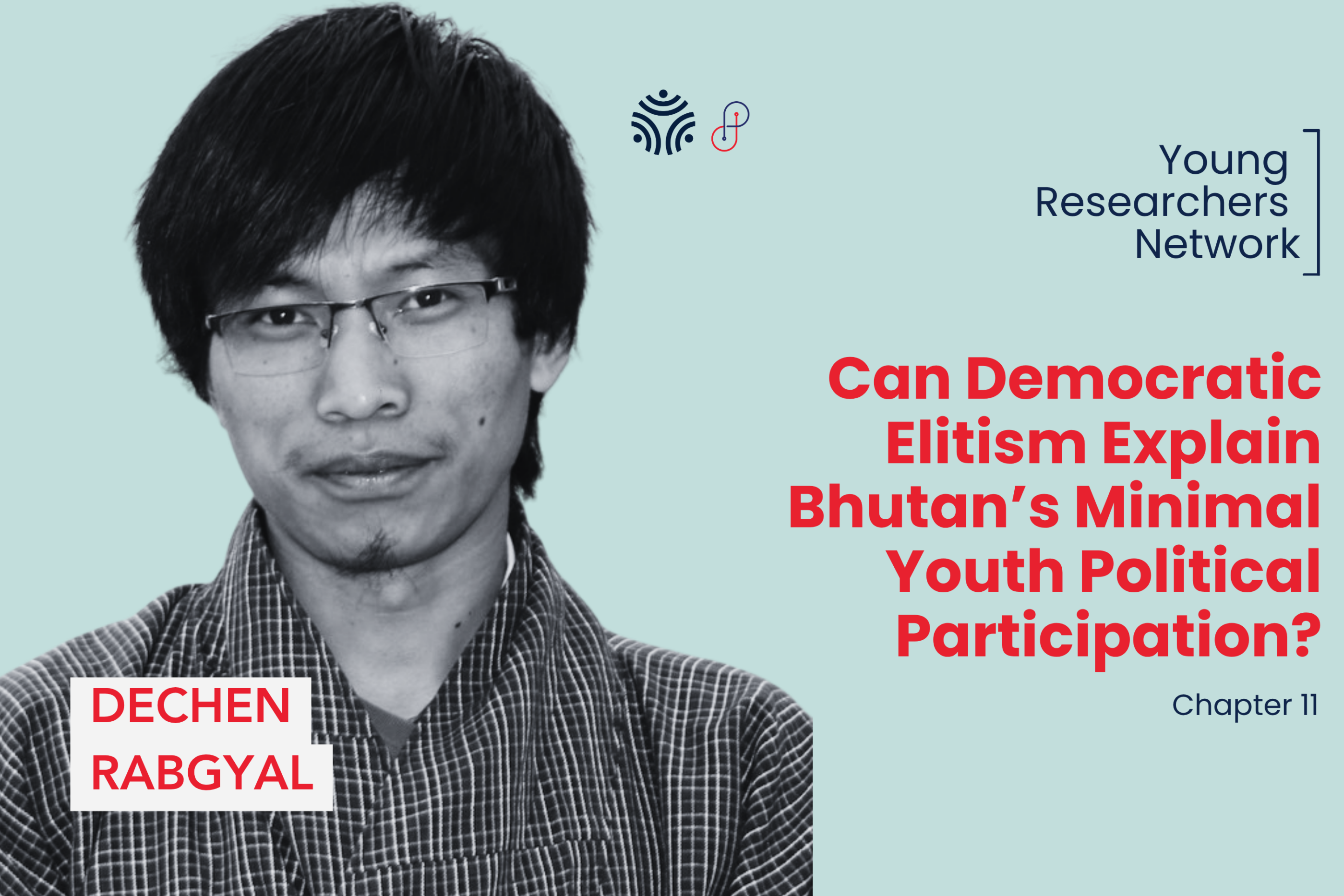
Dechen Rabgyal is an author and aspiring social scientist whose work draws on his rural Bhutanese upbringing and international education to examine public policy challenges and socio-political change in Bhutan.
Methodology
To explain the minimal level of political participation among young people in Bhutan, this study focuses on the concept of democratic elitism. Elitism is understood here to refer to an outlook that favours those with good educational qualifications and a high level of professional experience.
Through this lens, the study examines the factors that affect youth participation in Bhutan’s electoral politics. The research brought together four aspiring National Council candidates, including one former National Council member. None of the participants could run for election as they did not meet the 10-year experience criterion.
All four research participants took part in semistructured interviews that allowed for a deeper understanding of the respondents’ beliefs, attitudes, and opinions. Three of the participants also engaged in a focus group discussion, which provided exposure to group language and narratives by exploring specific topics among people of similar backgrounds and experiences.[vi] Held virtually, the discussion covered youth political participation, young people’s motivations to run for office, and the implications of recent electoral laws.
To maintain their confidentiality, the four participants were given the pseudonyms Dawa, Karma, Norbu, and Phuntsho.
Bhutan’s election rules
The rule of law is a foundation for any democratic polity. As one interviewee, Phuntsho, stated: “Laws should create enabling conditions for people to exercise agency and rationality, enabling youth political participation … to influence policies and programmes.” In that context, procedural incentives are important to promote young people’s participation.[vii]
In Bhutan, clear election procedures were established by the country’s constitution, which requires members of the National Council to be at least 25 years old, and the 2008 election act, which made it compulsory for candidates to have an undergraduate degree. The latter criterion emphasised the need for parliamentarians to have subject-matter expertise to be better able to study policies and legislation.[viii] This provision disappointed former representatives who had served in the old National Assembly between 1953 and 2007, as “they saw no place for themselves in the new parliamentary setup”.[ix]
When a draft of the 2008 election act was adopted the previous year, only 16,000 of the country’s then 634,000 inhabitants had an undergraduate degree.[x] This shows that the law represented an elitist approach to democracy: formal education was equated with competence, making democratic processes an arena for the qualified few – the academic elite.
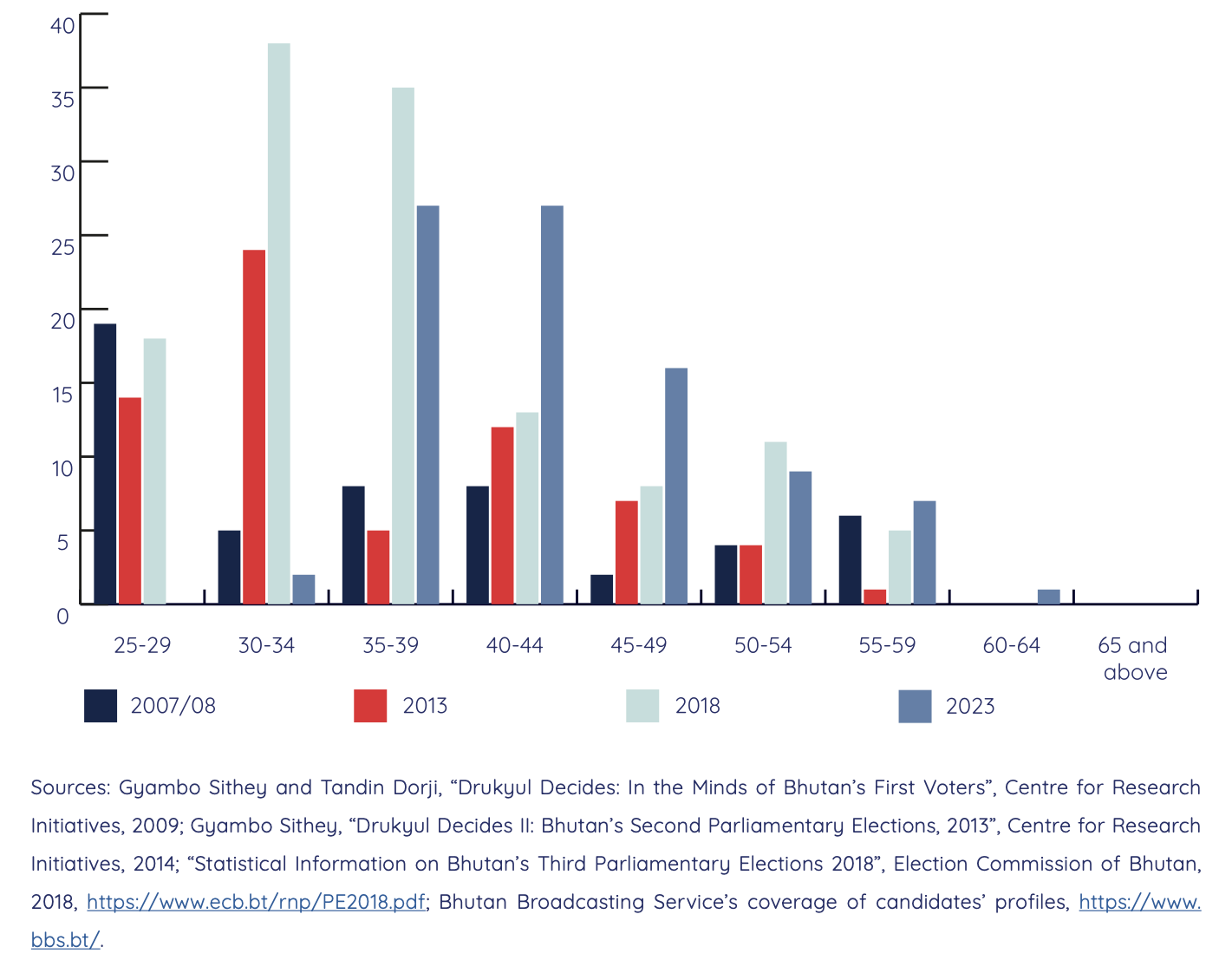
In each of the three National Council elections held from 2007 to 2018, the largest group of candidates consisted of those under the age of 35. These candidates are likely to have had less than 10 years’ professional experience, as most Bhutanese are around 23–24 when they complete their first university degree. In 2007–08, 19 out of 52 candidates were aged 25–29. By contrast, in the 2023 election, the first held after the introduction of the 10-year rule, there were no candidates in this age range (figure 11.1).
Figure 11.1. Number of candidates in National Council elections by age, 2007–23
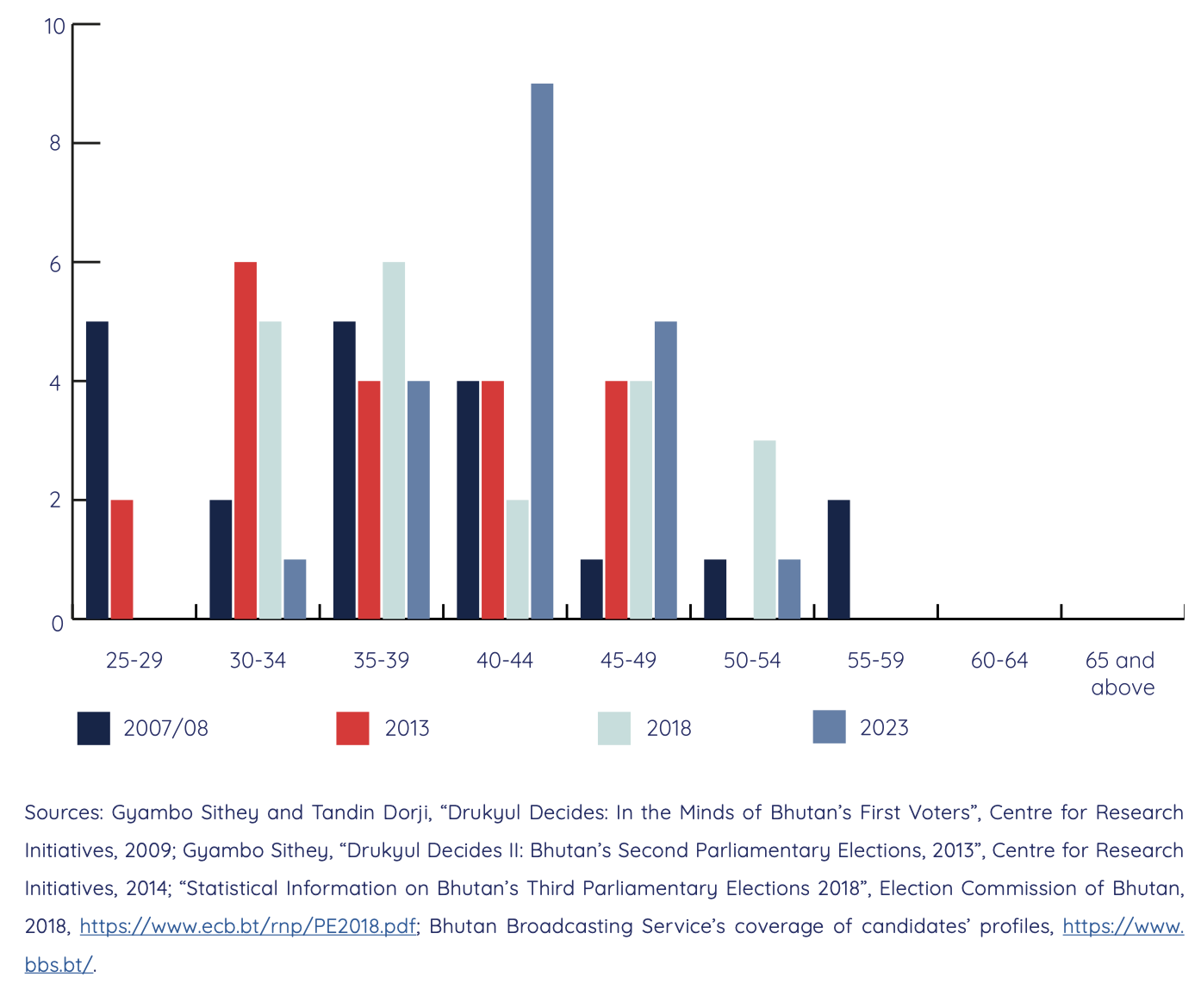
In the elections before 2023, some younger candidates were able to oust their older counterparts (figure 11.2).[xi] As long as younger candidates met Bhutan’s high legal benchmarks, informal societal norms and expectations did not prevent young Bhutanese from running for office.
Figure 11.2. Number of elected National Council members by age, 2007–23
Empowerment versus elitism
Engagement in civic and community projects encourages political participation.[xii] In Bhutan, democracy and civic-education programmes play an important role in socialising young people into mainstream politics. For example, Phuntsho was a member of the Youth Initiative launched in 2014 by the Bhutan Centre for Media Democracy. Modelled on youth parliaments in other countries, the initiative aimed to nurture and empower young people.[xiii]
In 2015, the election commission established the Bhutan Children’s Parliament (BCP) to foster the country’s future parliamentarians. The BCP’s members were elected from democracy clubs established in 2012.[xiv] However, the national parliament questioned the legitimacy of the BCP, which also suffered from the apprehension of its youth parliamentarians and criticism that Bhutan’s education system was being politicised.[xv]
Despite these initiatives, youth participation in Bhutan’s mainstream politics, such as elections, remained low. In the first round of the 2013 National Assembly election, only 26.6% of those aged 18–30 cast their vote. Five years later, 21.7% of those between the ages of 18 and 24 turned out to vote.[xvi] In the GYPI, Bhutan’s score for youth voter turnout was a meagre 21 out of 100, against a global average of 41.[xvii]
The 2022 rule change therefore came at a time when youth enthusiasm in mainstream politics – in terms of voter turnout – was already low. The 10-year work experience requirement made Bhutan’s electoral laws more restrictive and turned electoral politics into the mainstay of a gerontocracy that undermined the younger generation while protecting the old.[xviii] The pre-existing requirements of a minimum age limit of 25 and an undergraduate degree were already high benchmarks.[xix] As early as 2019, critics had argued for the removal of the requirement of an undergraduate degree.[xx]
Yet Bhutanese lawmakers and authorities have a deep-seated inclination towards an elitist, competence-based approach to democracy. Back in 2007, the National Assembly proposed that candidates should have at least eight to 10 years of work experience. The proposal was turned down, as a 10-year experience rule would have taken the effective minimum age to 34, since most Bhutanese complete their undergraduate studies at 23 or 24. This would have been at odds with the constitutional requirement of a lower age limit of 25.
In 2014, the National Council similarly proposed requiring its members, except for incumbents, to have 10 years’ work experience, with the aim of ensuring that members had the competence to review draft legislation.[xxi] According to one analysis, the proposal had “heavy overtones of elitism and an air of preserving the old boys’ club”.[xxii] Again, the National Assembly decided against introducing the requirement.[xxiii]
Experience over aspiration
The 2022 rule made several aspiring candidates ineligible for election. Supporters of the new rule argued that professional experience would bring mature, well-educated, capable people with real-life professional experience into Bhutan’s legislature.[xxiv] According to one former member of the National Council, intellectual competence and professional integrity come with age.[xxv] There were concerns that the previous system had allowed well-connected candidates, who were not necessarily the most capable, to be elected.[xxvi]
Young people were seen as lacking the competencies needed to shoulder the burdens of parliamentary office.[xxvii] The rule change to privilege older, more mature, more capable, and more experienced candidates was supposedly geared towards maintaining democratic stability and coherent public policy, an approach best explained as an example of elitism.[xxviii]
Young Bhutanese never lacked motivation to run for public office. One interviewee, Karma, had left a postgraduate studies opportunity to stand in the 2023 National Council election. Norbu, a former National Council member, said: “I was prepared to [stand for election again] to serve the people with more experience and maturity.” For Phuntsho, his engagement in various social activities and volunteerism awakened his political consciousness. Three interviewees – Karma, Dawa, and Phuntsho – were politically socialised and driven by their respective desires to contribute to decision-making, change political outcomes, and pursue the common good.
Yet for all four interviewees, their ambitions were quashed by the new rule. Norbu’s skills and knowledge from his previous term in office, Karma’s social capital and network, Phuntsho’s aspiration to influence political outcomes, and Dawa’s commitment to duty – all factors that encouraged political participation – were swept aside by the fact that they did not meet the professional experience requirement. The new rule inadvertently became anathema to the would-be candidates’ processes of political socialisation. The focus on professional experience solidified Bhutanese lawmakers’ long-standing assumption of a strong link between competence and age. Leadership skills and youthful dynamism were seen as mutually exclusive.
The 2022 rule change challenged parliamentary supremacy and became more powerful than the 2008 election act, as the numbers of candidates and elected members in the 2023 National Council election confirm.[xxix] There were only two candidates under the age of 35, one of whom was elected.
The implications of the rule change on the motivations of young Bhutanese were significant. In the words of Dawa: “It felt like everything vanished overnight.” He continued: “The rule affected my enthusiasm, my energy … it was all drained out … I do not think we would have the same energy to come and contest in the elections [in the future].” Phuntsho reflected: “I could not participate, but that is it. It was not the end of everything for me.” But he went on to say: “I do not think I will be joining politics anymore.”
Norbu, however, said: “I will contest future elections with more experience and exposure.” The impact of structural constraints on young people’s political engagement is therefore not universal, as Norbu’s persistence attests. Yet of the four interviewees, three were discouraged from participating in future. Bhutan’s elitist approach to election rules, and to politics in general, looks set to have an effect on young people’s long-term commitment to public service and political office.
Conclusion
Young people have been referred to as “standby citizens”.[xxx] Their low levels of political engagement have been attributed to unequal access to social services, a lack of political influence, and a lack of trust in political parties and politicians. The political climate and the discourse of youth engagement in Bhutan are no different from elsewhere, albeit with a unique national context.
Even before 2022, the minimum requirements for Bhutanese wanting to run for elected office – a lower age limit of 25 and an undergraduate degree – already set a high bar. Still, before the new rule was adopted requiring 10 years’ professional experience, the largest group of candidates for National Council elections consisted of those under 35 years of age, who may not necessarily have had 10 years of experience. Indeed, democracy and civic-education programmes, a sense of duty, and a motivation to serve all empowered young people to run for political office.
However, the requirement of 10 years’ work experience has made elected office a stronghold of the experienced and educated few, an outcome best explained as an elitist approach to democracy. Young people, previously keen to run for office, are left disappointed, and their motivation to take part in future elections may be affected. This trend, with its outcome of lower political participation, effectively cancels out young people’s gains from their initial political socialisation, the benefits of which would otherwise increase as democracy matures. At the same time, voter turnout among young Bhutanese continues to be lower than the global average.
Future research could build on this study by broadening the sample size to include not only the National Council but also the National Assembly. The impact of the 2022 rule on young people’s motivation and the composition of Bhutan’s two houses of parliament could be studied comparatively to gauge parliamentary dynamics, political participation, and the broader impact on democracy.
Further, a quantitative approach could generate data on correlation and causation, which would provide a better understanding of the impacts of legislative interventions such as eligibility criteria on youth participation. This would be an important lens through which to assess the expectation that democracy becomes more representative, participatory, and competent as it takes root.
This chapter is part of a Deep Dive of Young Researchers who worked on Youth Participation for three years. This deep dive is a global collection of 12 case studies unpacking how young people are reshaping political engagement.
The Young Researchers’ Network is an initiative developed in the framework of the European Democracy Hub and EPD’s Women and Youth in Democracy WYDE Civic Engagement project, supported by the European Union.
[i] Siok Sian Pek-Dorji, “Youth and Politics in an Evolving Democracy”, The Druk Journal 4, no. 1 (2018): 72–8, https://drukjournal.bt/youth-and-politics-in-an-evolving-democracy/.
[ii] “Country Profiles: Bhutan”, Global Youth Participation Index, European Partnership for Democracy, 2025, https://gypi.epd.eu/country-reports/bt.
[iii] “Population Projections Bhutan 2017-2047”, Bhutanese National Statistics Bureau, 2019, https://www.nsb.gov.bt/publications/census-report/.
[iv] According to their functions, the National Council may be considered equivalent to the upper house in a western political system and the National Assembly to the lower house. However, no reference is made to upper and lower houses in the Bhutanese context.
[v] “Rules on Elections Conduct in the Kingdom of Bhutan”, vol. 4.3.3.1, Election Commission of Bhutan, 2022, https://www.ecb.bt/Rules/conductofelections.pdf.
[vi] Lokanath Mishra, “Focus Group Discussion in Qualitative Research”, TechnoLearn: An International Journal of Educational Technology 6, no. 1 (2016): 1–5, https://doi.org/10.5958/2249-5223.2016.00001.2.
[vii] Jan Teorell, “Political Participation and Three Theories of Democracy: A Research Inventory and Agenda”, European Journal of Political Research 45, no. 5 (2006): 787–810, https://doi.org/10.1111/j.1475-6765.2006.00636.x.
[viii] “Bhutan National Human Development Report: Ten Years of Democracy in Bhutan”, Parliament of Bhutan and United Nations Development Programme, 2019, https://hdr.undp.org/system/files/documents/nhdr-2019ii.pdf.
[ix] Kunzang Wangdi, “Growing up with Modern Bhutan”, Cho Sid Public Policy Publications and Studies, 2024.
[x] “Bhutan (Gyelyong Tshogde) Elections in 2007”, Inter-Parliamentary Union, 2025, http://archive.ipu.org/parline-e/reports/arc/2036_07.htm.
[xi] Needrup Zangpo, “Bhutan’s National Council Election 2023: A Setback for Women”, Friedrich Naumann Foundation, 29 June 2023, https://www.freiheit.org/south-asia/bhutans-national-council-election-2023-setback-women.
[xii] Teorell, “Political Participation”.
[xiii] Dechen Rabgyal, Youth Civic Engagement: Concepts, Agents, Reflections and Empowerment (Trashigang: Sherubtse College, 2018).
[xiv] Wangdi, “Growing up”.
[xv] Pek-Dorji, “Youth and Politics”.
[xvi] Dechen Rabgyal, “Forces Shaping Bhutan’s Young Social Capital”, The Druk Journal 7, no. 1 (2021): 118–26, https://drukjournal.bt/wp-content/uploads/2021/05/Forces-Shaping-Bhutans-Young-Social-Capital.pdf.
[xvii] “Bhutan”, European Partnership for Democracy.
[xviii] Dechen Rabgyal, “From Votes to Voices: Socialise Politics and Normalise Public Affairs to Address Bhutan’s ‘Democratic Dilemma’”, Dechen Rabgyal, 30 October 2022, https://www.dechenrabgyal.com/2022/10/30/from-votes-to-voices-socialise-politics-and-normalise-public-affairs-to-address-bhutans-democratic-dilemma/; Yeshey Lhaden, “10 Years Work Experience Mandatory to Contest for National Council – BBSCL”, BBSCL, 30 January 2014, https://www.bbs.bt/36769/.
[xix] Tenzing Lamsang, “Ruling and Opposition Parties Uneasy with ECB’s New Rules on Experienced Candidates and Showing Money for Pledges but 3 Other Parties Welcome It”, Bhutanese, 3 September 2022, https://thebhutanese.bt/ruling-and-opposition-parties-uneasy-with-ecbs-new-rules-on-experienced-candidates-and-showing-money-for-pledges-but-3-other-parties-welcome-it/.
[xx] “Bhutan”, Parliament of Bhutan.
[xxi] Lhaden, “10 Years”; “Proceedings and Resolutions of the Twelfth Session”, National Council of Bhutan, 2014.
[xxii] “House of Review Needs to Review Its Experience Criteria”, Bhutanese, 15 February 2014, https://thebhutanese.bt/house-of-review-needs-to-review-its-experience-criteria/.
[xxiii] “Proceedings and Resolutions of the National Assembly of Bhutan: Second Parliament of Bhutan, Fourth Session”, National Assembly of Bhutan, 2014; “Proceedings and Resolutions of the Thirteenth Session”, National Council of Bhutan, 2014.
[xxiv] Zangpo, “Bhutan’s National Council Election 2023”; Lamsang, “Ruling and Opposition Parties”.
[xxv] Pema Choki, “The Increasingly Important Role of the National Council over the Last 15 Years”, Bhutanese, 2023, https://thebhutanese.bt/the-increasingly-important-role-of-the-national-council-over-the-last-15-years/.
[xxvi] Nidup Lhamo, “Seminar Participants Question ECB on New Rules”, Business Bhutan, 24 October 2022, https://businessbhutan.bt/seminar-participants-question-ecb-on-new-rules/.
[xxvii] Jack L. Walker, “A Critique of the Elitist Theory of Democracy”, American Political Science Review 60, no. 2 (1966): 285–95, https://doi.org/10.2307/1953356.
[xxviii] Fredrik Engelstad, “Democratic Elitism – Conflict and Consensus”, Comparative Sociology 8, no. 3 (2009): 383–401, https://doi.org/10.1163/156913309×447585; Robert A. Dahl, “Further Reflections on ‘the Elitist Theory of Democracy’”, American Political Science Review 60, no. 2 (1966), 296–305, https://doi.org/10.2307/1953357.
[xxix] Kinley Wangchuk, From Armed Parliamentarians to Peaceful Debates: Principles and Practices of Bhutan’s Democracy (Thimphu: Kinley Wangchuk, 2024).
[xxx] Erik Amnå and Joakim Ekman, “Standby Citizens: Diverse Faces of Political Passivity”, European Political Science Review 6, no. 2 (2014): 261–81, https://doi.org/10.1017/s175577391300009x.