
A Comparative Study of Political Generations in Australia
In most advanced democracies, declining electoral turnout is disproportionately concentrated among young people.[i] For example, in the 2024 United Kingdom general election, less than half of 18- to 24-year-olds cast a ballot, compared with three-quarters of people aged 65 or above.[ii] Similar trends were seen in recent elections in France and Germany, where young people were considerably less likely to vote than older people.[iii]
Low electoral engagement underscores democratic inequality: those who are economically and socially disadvantaged abstain from taking part.[iv] This then introduces a representation bias in public policy, reduces government responsiveness, and compromises political competition.[v]
With its strictly enforced compulsory voting, Australia has not suffered a similar fall in youth turnout in federal and state elections. Compulsory voting ties young people to the political system, even when they are disillusioned by mainstream party politics. This is almost an enforced exposure to the political system, which prevents apathy and disenfranchisement and stops young people from turning away from democratic politics. Does this mean that youth democratic engagement in Australia manifests itself differently from elsewhere?
The reasons for examining the Australian experience are twofold. First, despite compulsory voting, there has been a gradual and continued decline in Australians’ trust in politics since 2007.[vi] Satisfaction with democracy has fallen rapidly, in 2019 reaching its lowest level since the 1970s.[vii] Second, both major political parties have seen a steady decline in their support over the past two decades; they won less than 70% of the primary vote between them in the 2022 and 2025 federal elections.[viii] This remarkable drop-off is attributed to poor performances by successive governments and a broad detachment from politics across generations. Voters’ poor evaluations of the country’s governance are also reflected in a rise in support for minor parties and independent candidates.
Once among the most satisfied democratic nations in the world, Australia scored a modest 79 out of 100 in the European Partnership for Democracy’s 2025 Global Youth Participation Index, owing to a lack of youth disengagement and youth-focused policies and candidates.[ix] Australia’s score of 64 out of 100 on the index’s political affairs dimension reflects young people’s moderate representation in parliament and party structures, an absence of youth quotas, and young people’s limited influence in leadership roles. Disillusionment with formal institutions is rising among young Australians, especially as public spending is skewed towards older demographics, despite economic pressures on younger workers.
This study investigates how and why young Australians are reshaping the political landscape. Looking at intergenerational differences in democratic engagement, the research draws implications for future political-party competition in Australia. The chapter shows that young people are increasingly willing to explore alternatives to the major parties. This signals that future parliaments will increasingly instil a balance of power in non-established minor parties and independents. But as the Australian electorate evolves to become more aligned by issue than by party, no political actor can take the youth vote for granted. Australian politicians will have to adapt to the changing policy priorities of younger generations to gain and retain support from election to election.

Dr. Intifar Chowdhury is a political scientist and youth researcher whose work focuses on strengthening democratic participation and representation among young people, combining academic research with public engagement and policy-relevant commentary.
Background and approach
To avoid the misunderstanding that young people are disengaging from the democratic system in Australia, it must be stressed at the outset that there is no evidence of a decline in youth commitment to democracy as a desired system of government.
This chapter focuses on generational replacement or change as the key explanation of youth engagement. People socialise politically in their formative years, when they develop certain patterns of behaviour based on their experiences in late adolescence and early adulthood. These attitudes persist throughout their lives and are resistant to change from new developments.[x] Generational replacement occurs when younger generations, who are socialised in different historical periods, replace older cohorts.
Generational cohorts differ because of slow evolutionary change. The underlying mechanism is the accumulation of certain characteristics due to societal transformations, such as a rise in education or the development of new technologies. These transformations are different from disruptive events like wars or pandemics. The events of specific time periods can also impact democratic attitudes and behaviours, but these effects influence the entire population rather than just people in their formative years. Therefore, there is a distinction between lasting characteristics and sudden changes in political behaviour that are particular to a given cohort.
The gradual decline in political engagement across generations provides support for societal modernisation, which is a long, continuous process of transformations, rather than a one-off feature. The withdrawal from traditional practices is due to lasting generational characteristics and is not unique to one cohort, meaning it does not subsequently fade away.
This chapter highlights how Australia’s younger generations, despite being equally committed to democracy, interact with traditional political institutions, such as political parties and elites, differently from older generations. The study covers the six generations since 1915 (table 12.1).
Table 12.1. The six generations included in this study
The generational change in Australia’s electoral politics away from traditional party loyalties can be referred to as voter de-alignment. This concept describes a drift away from political parties altogether, as opposed to voter realignment, where voters shift their loyalties from one party to another.[xi]
Features of realignment include new voting coalitions and parties winning over groups that were not previously theirs. By contrast, de-alignment is characterised by a rising number of independent candidates, declining partisan identification, and more volatile voting, where issues matter more than party loyalties in determining voters’ choices from one election to the next. When partisan weakening happens for a sustained period across generations, it reflects a lasting generational shift rather than a temporary youth rebellion that tends to moderate with age.
This chapter uses nationally representative post-election survey data from the Australian Election Study (AES), collected between 1987 and 2022, to look at political orientations, government evaluations, and voting patterns across generations.[xii] It uses descriptive and inferential statistics to reveal generational and voter groups that are turning away from major parties. A limitation of this cohort approach is that the effects of factors such as age and time period are not isolated from generational effects. But a 2021 study attempted to separate these effects in Australia and concluded that fixed generational effects are the most important in explaining youth (dis)engagement.[xiii]
How young people are changing politics
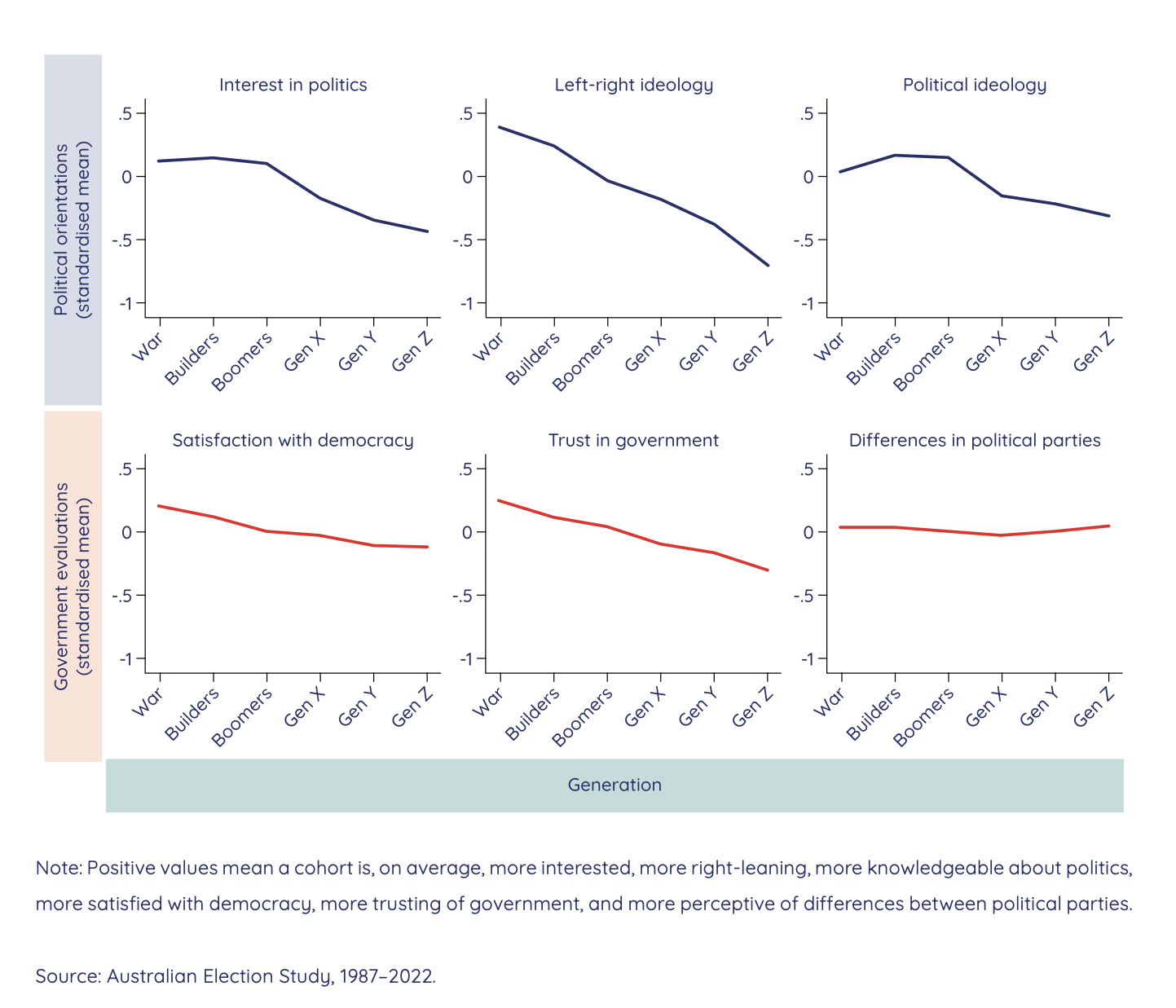
In terms of their political orientation, young Australians tend to be less interested in politics, more progressive or left-wing in their political views, and less knowledgeable about political facts than their predecessors (figure 12.1, top row). Meanwhile, when it comes to evaluations of governments, young people are less likely to be satisfied with democracy and less likely to trust the government than older generations (figure 12.1, bottom row).[xiv] All generations are comparable in the differences they see between the two major political parties, the centre-left Labor Party and the centre-right Liberal Party.
Figure 12.1. Generational trends in political orientation and government evaluation
Poor evaluations of governance are also reflected in the rise in support for minor political parties and independent candidates.[xv] In 1980, non-major groups accounted for only 8% of the vote. By 2025, this had increased to 34%, the highest share ever recorded when a major party received fewer votes than independents and minor parties.[xvi] This trend is mirrored in Australia’s states and territories, where all jurisdictions have experienced some form of power sharing.
Although young voters remain engaged at the polls, thanks in part to compulsory voting, they are also abandoning party loyalties. Younger generations are less likely to align with a major party, less likely to consistently vote for the same party, and more likely to change their voting intention during election campaigns (figure 12.2).[xvii]
Figure 12.2. Partisan stability and vote switching by generation
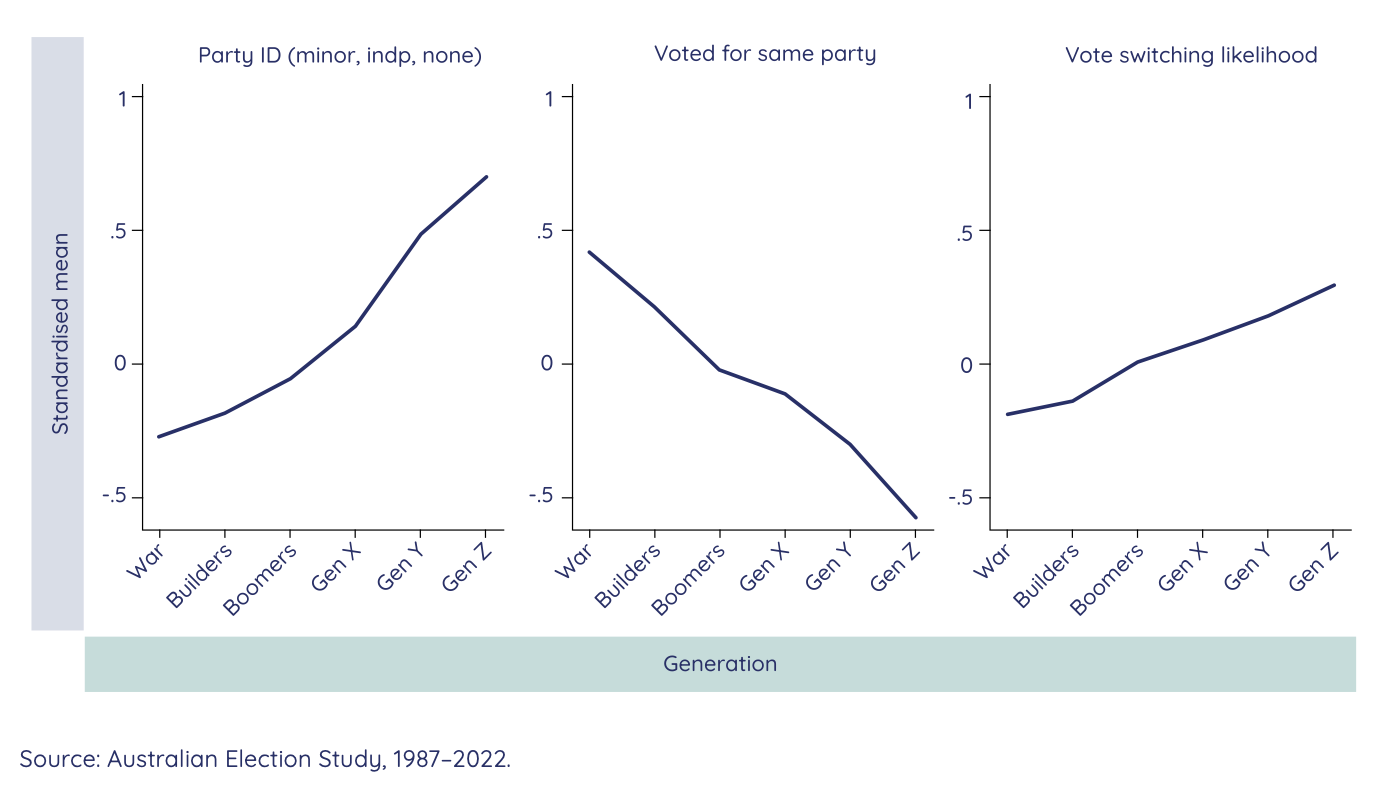
The decrease in the major parties’ primary vote share, the rise of minor parties, the erosion of previously strong predictors of electoral choice, the increase in issue-based voting, and the increase in swing and undecided voters all point to a fragmented but more responsive electorate. The decline in the number of people who identify with a political party provides stark evidence of voter volatility and partisan de-alignment.
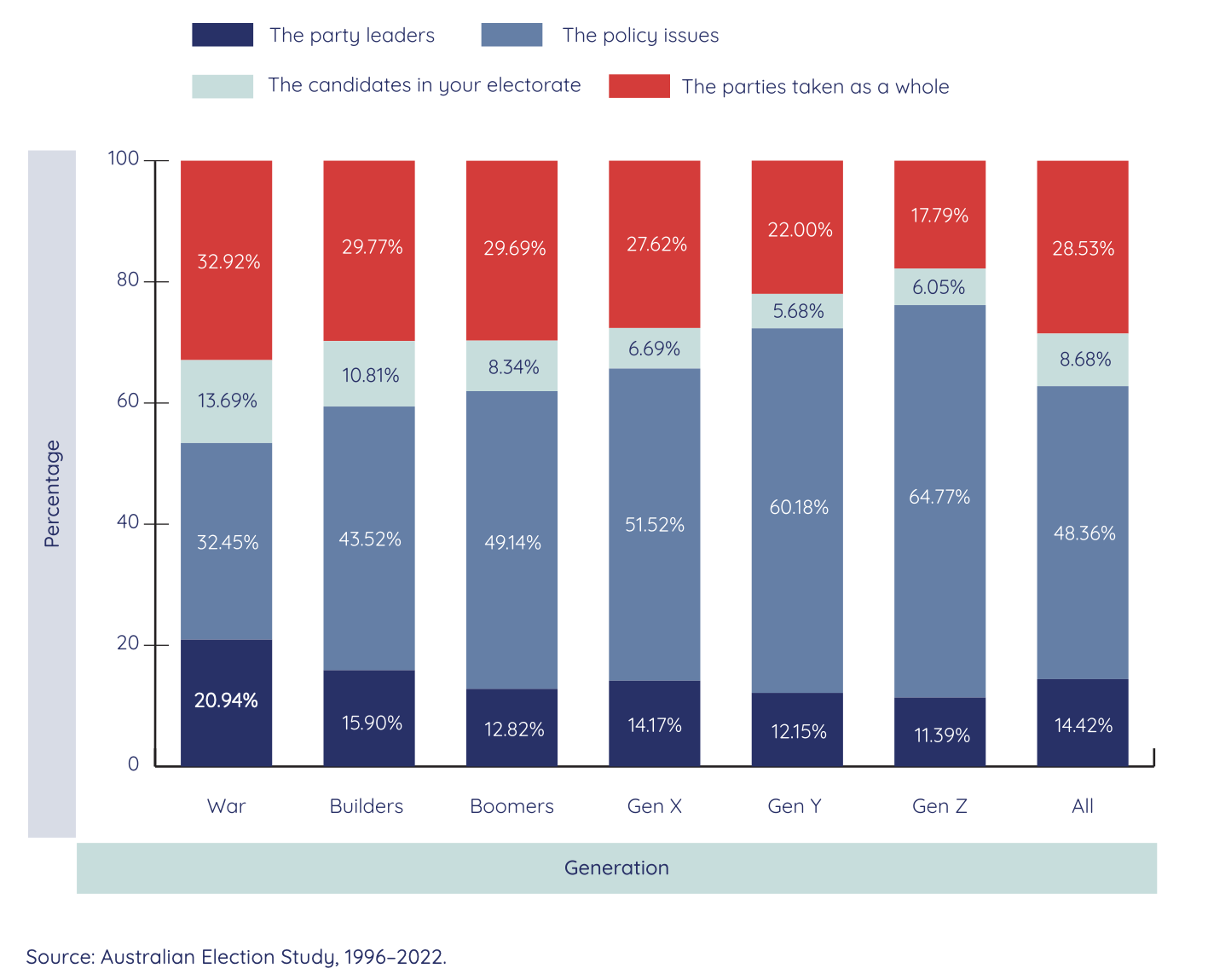
Alongside these trends, the political context of each election is crucial. Over the period of the AES, voting decisions have increasingly been driven by policy issues, with 48% of all Australians surveyed from 1996 to 2022 citing these as the primary factor (figure 12.3). This is followed by party affiliation (29%), party leaders (14%), and local candidates (9%). In 2022, 54% of voters reported policy issues as the main factor that influenced their vote choice. Across the generations, Gen Z is more issue aligned than party aligned.
Figure 12.3. Most important factors in voting decisions by generation
These findings support the societal modernisation theory and the cognitive mobilisation thesis that a changing social context is characterised by long-term societal transformations that encourage young people to withdraw from traditional democratic processes.[xviii] As a result, there is conclusive evidence that the modern-day democrat is assertive, demanding, and punitive. Today’s young people are fluid citizens who change their party loyalties and act based on political issues that directly impact their lives.
Why young people are changing politics
The reason young people’s politics have changed is that young Australians today face a vastly different set of challenges from their parents and grandparents. While they may earn more in nominal terms than previous generations, today’s young people are burdened by rising living costs, escalating education expenses, insecure employment, and growing debt.[xix] Structural shifts in the economy and the labour market have reshaped young adulthood, delaying key milestones like homeownership, long-term partnerships, and parenthood.
University participation has increased, but so too has student debt – well beyond what was envisaged when Australia introduced the Higher Education Contribution Scheme in 1989 as a fair, income-contingent loan system.[xx] Indexation has historically outpaced wage growth, leaving today’s 20-somethings with debts over A$10,000 (US$7,000) – higher in real terms than their counterparts two decades ago. Credential inflation has transformed the job market, with even low-wage roles now requiring a university degree.[xxi] Many graduates find themselves in jobs unrelated to their qualifications, with job mismatch rates among 25-year-olds rising from 28.5% in 1996 to 33% by 2019.[xxii]
Housing affordability has also deteriorated. In 2000, the average house in Australia cost around nine times the average household income; by 2024, that figure had risen to 16.4 times.[xxiii] Since 2001, property prices have outpaced incomes by a factor of 2.3.[xxiv] This was driven in part by tax incentives like the capital gains tax discount introduced in 1999 by the government of Prime Minister John Howard and, more recently, by demand in the era of the Covid-19 pandemic.[xxv] While schemes like the First Home Owner Grant offer some support, saving for a deposit remains a years-long challenge for most.
For many in Australia, intergenerational wealth is now the key to homeownership. Since 2002, the total value of wealth transfers has more than doubled in real terms, with inheritances expected to quadruple by 2050.[xxvi] Yet because parental wealth is unevenly distributed, inheritance is set to deepen inequality within the youth cohort.
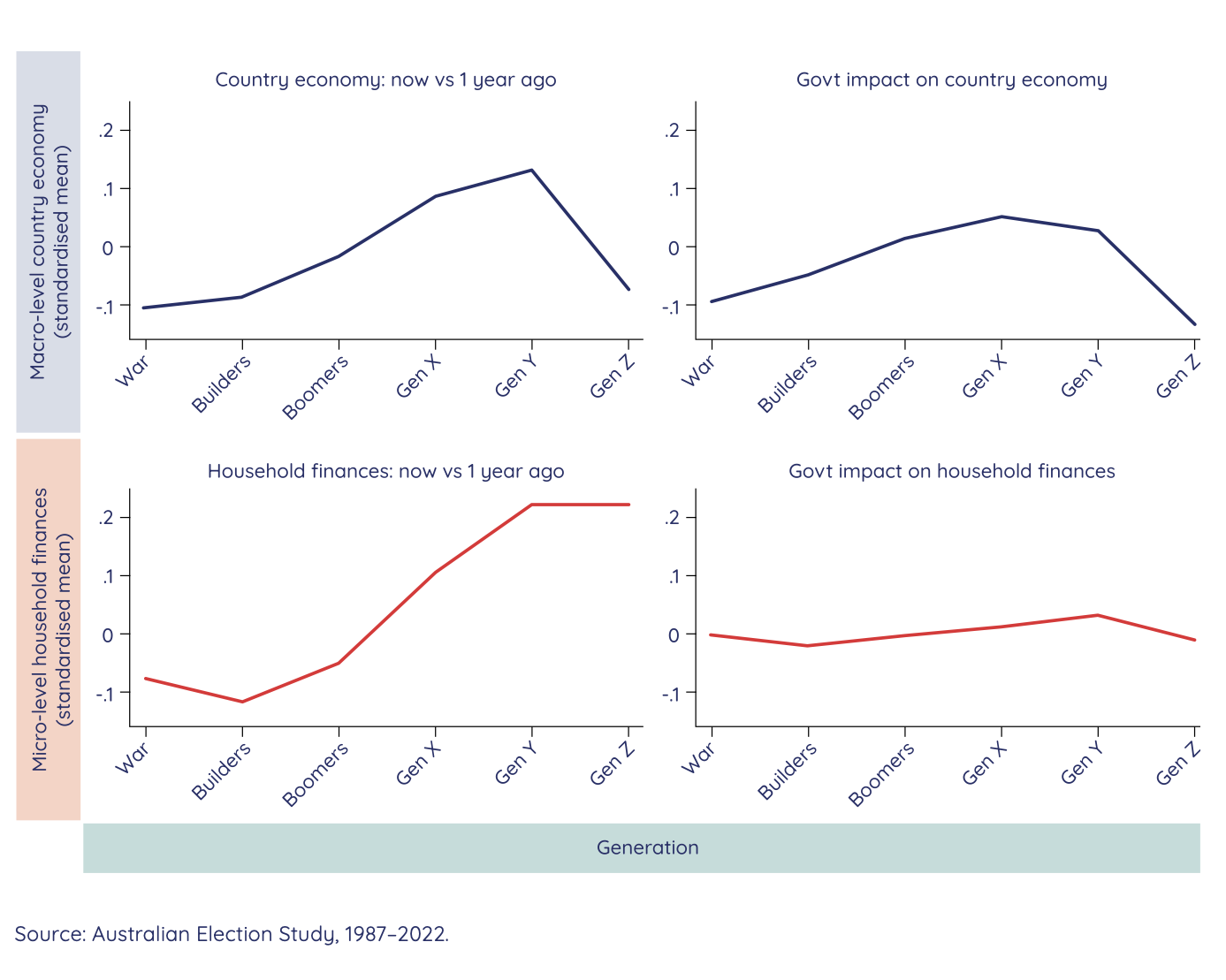
In short, young Australians are staying younger for longer. The traditional path to adulthood – stable work, savings, and homeownership – has been disrupted and delayed. It is no surprise, then, that many young people feel let down by government policy. According to the 2024 Australian Youth Barometer, 62% believe they will be worse off than their parents.[xxvii] As for different generations’ perceptions of the national economy (figure 12.4, top row) and of household finances (figure 12.4, bottom row), Gen Z seem to be most unimpressed by the impact of government policies.
Figure 12.4. Perceptions of the national economy and of household finances by generation
Implications for party politics
Australia’s demographic shift has enabled the Greens to capitalise on generational replacement as younger voters gradually displace older generations at the polls. Young people’s de-alignment away from the major parties represents a critical disadvantage to the centre right.[xxviii] Meanwhile, Labor has positioned itself as the preferred party in Australia’s two-party system when it comes to addressing these critical issues, alongside the rising cost of living.
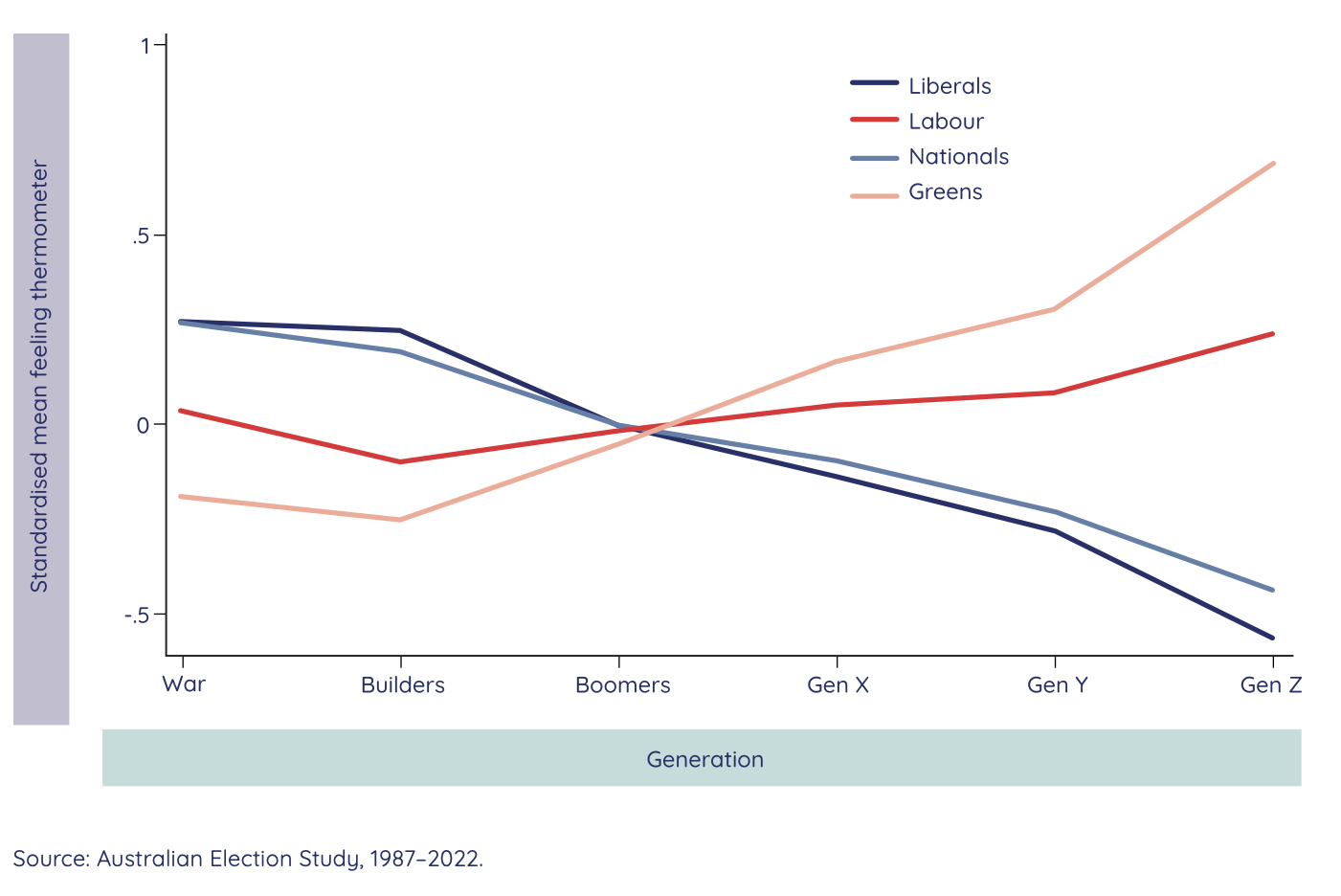
Across the generations, the Coalition partners – the Liberal Party and the centre-right National Party – have become increasingly unfavourable as younger generations tend to feel more positively towards left-of-centre parties (figure 12.5). With centre-left issues gaining traction, the Coalition is likely to see a further erosion of its support among younger voters.[xxix]
Figure 12.5. Generational trends in feelings towards political parties
Conclusion
Australia’s younger generations are reshaping the country’s politics not only through their values but also through their lived experiences. Members of Gen Z, like their millennial predecessors, are navigating a delayed and disrupted transition to adulthood, marked by insecure work, rising debt, unaffordable housing, and climate change anxiety.[xxx] These conditions have fuelled disillusionment with the major parties and driven a shift towards issue-based, swing voting. In a political landscape where stability feels out of reach, young Australians are demanding something different, and their politics are starting to reflect it.
The root cause of youth disengagement from major parties may be the fact that generational change was not accompanied by political reform, widening the gap between the elites and the underrepresented. Unlike previous generations, today’s young people hold more postmaterialist and progressive values and are less likely to align with political parties. Instead, they choose to act based on specific issues, like climate change, education equity, and housing affordability – issues often sidelined by mainstream parties.
This benefits minor parties, but in a two-party system like Australia’s, young voters’ shift away from major parties has significant implications. It must be acknowledged that disengagement in any form is not good news for democracy. Young citizens may choose to disengage and remain apathetic, perhaps because of a reduced belief in the efficacy of the government system. However, disillusionment leads to misrepresentation, and this is harmful both for young constituents and for the overall health of the democratic system.
This disconnect highlights a deeper problem: traditional institutions, such as political parties, are failing to adapt to the priorities of younger generations. The entry of a younger, more diverse electorate will influence political priorities. If parties fail to respond to voters’ concerns, there is a growing risk of political disengagement or backlash, particularly through support for minor parties and independents. There were already signs of this in the 2022 federal election, and again in the 2025 election, when the primary vote in the lower house was divided almost evenly three ways between Labor, the Coalition, and minor parties and independents.[xxxi]
To stay in the game, major parties need major resets. Party systems are highly adaptive and have done this before. An influential 1967 perspective that described the evolution of democratic party systems focused on cleavages: the deep social, economic, and cultural divisions that structure political competition and shape the emergence of key party units.[xxxii] For example, labour parties emerged to represent working-class interests. With younger generations quite distinct from older ones in their economic and social experiences and prospects, a new generational cleavage has emerged. Younger and older voters have different policy priorities, which shape new political divisions and party strategies. What is more, these priorities change from election to election.
In the immediate future, Australia may well see more minority governments and a fragmentation of the two-party system. A big challenge for the country’s major parties is to take the pulse of the nation, which now comprises a more volatile voter base, to build and then rebuild coalitions of electoral support at each contest.
This chapter is part of a Deep Dive of Young Researchers who worked on Youth Participation for three years. This deep dive is a global collection of 12 case studies unpacking how young people are reshaping political engagement.
The Young Researchers’ Network is an initiative developed in the framework of the European Democracy Hub and EPD’s Women and Youth in Democracy WYDE Civic Engagement project, supported by the European Union.
[i] Filip Kostelka and André Blais, “The Generational and Institutional Sources of the Global Decline in Voter Turnout”, World Politics 73, no. 4 (2021): 629–67; Gerardo Berthin, “Why Are Youth Dissatisfied with Democracy?”, Perspectives, Freedom House, 14 September 2023.
[ii] Jamie Morris, “‘It’s a vicious cycle why many young people don’t vote’”, BBC News, 28 June 2024.
[iii] Bastian Herre, “Young People Are Less Likely to Vote than Older People — Often Considerably So”, Our World in Data, 3 July 2024.
[iv] Ruth Dassonneville and Marc Hooghe, “Voter Turnout Decline and Stratification: Quasi-Experimental and Comparative Evidence of a Growing Educational Gap”, Politics 37, no. 2 (2017): 184–200.
[v] André Blais et al., “Where Does Turnout Decline Come From?”, European Journal of Political Research 43, no. 2 (2004): 221–36.
[vi] Ruth Dassonneville and Ian McAllister, “Explaining the Decline of Political Trust in Australia”, Australian Journal of Political Science 56, no. 3 (2021): 280–97.
[vii] Sarah Cameron, “Government Performance and Dissatisfaction with Democracy in Australia”, Australian Journal of Political Science 55, no. 2 (2020): 170–90.
[viii] Bill Browne and Minh Ngoc Le, “The Steady Decline of Voters Choosing the Major Parties Is Reshaping Australian Politics”, Australia Institute, 24 October 2024; Skye Predavec, “The 2025 Federal Election Is the First Where a Major Party Received Fewer Votes than Independents and Minor Parties”, Australia Institute, 4 June 2025.
[ix] “Explore Youth Participation in Australia”, Global Youth Participation Index, European Partnership for Democracy, 2025.
[x] Mark N. Franklin, Voter Turnout and the Dynamics of Electoral Competition in Established Democracies Since 1945 (Cambridge: Cambridge University Press, 2004).
[xi] Paul Webb and Tim Bale, “Understanding Electoral Change: Realignment or Dealignment?”, in The Modern British Party System, 2nd edition (Oxford: Oxford University Press, 2021).
[xii] Ian McAllister et al., “Australian Election Study Integrated Time Series Data”, ADA Dataverse, V3, 2024, https://doi.org/10.26193/HJ3KT1.
[xiii] Intifar S. Chowdhury, “Are Young Australians Turning Away from Democracy?”, Australian Journal of Political Science 56, no. 2 (2021): 171–88.
[xiv] Cameron, “Government Performance”; Dassonneville and McAllister, “Explaining”.
[xv] Cameron, “Government Performance”; Browne and Le, “The Steady Decline”.
[xvi] Predavec, “The 2025 Federal Election”.
[xvii] Intifar S. Chowdhury, “Every Generation Thinks They Had It the Toughest, but for Gen Z, They’re Probably Right”, The Conversation, 21 March 2025.
[xviii] Russell J. Dalton, Scott C. Flanagan, and Paul A. Beck, Electoral Change in Advanced Industrial Democracies (Princeton: Princeton University Press, 1984); Russell J. Dalton, The Apartisan American: Dealignment and Changing Electoral Politics (Washington, DC: CQ Press, 2013).
[xix] Chowdhury, “Every Generation”.
[xx] Greg Jericho and Jack Thrower, “People are starting with much larger HECS/HELP debts than in the past – and it is only going to get worse”, Off the Charts, Australia Institute, 23 April 2024.
[xxi] Tom Karmel, “The Return to Education – An Occupational Perspective”, Mackenzie Research Institute, November 2023.
[xxii] Derby Voon and Paul W. Miller, “Undereducation and Overeducation in the Australian Labour Market”, Economic Record 81 (2005): S22–S33; Intifar S. Chowdhury, Ben Edwards, and Andrew Norton, “Youth Education Decisions and Occupational Misalignment and Mismatch: Evidence from a Representative Cohort Study of Australian Youth”, Oxford Review of Education 50, no. 5 (2024): 727–47.
[xxiii] Greg Jericho, “The ‘Good Old Days’ for Housing Affordability Were Just Four Years Ago – Here’s Why”, Grogonomics, Guardian, 14 March 2024.
[xxiv] Greg Jericho, “It’s Time We Asked: What Is the Cost Not Just to the Budget, but to Society, When the Richest Are Helped to Get Richer?”, Grogonomics, Guardian, 27 February 2025.
[xxv] Gavin Wood, “Sustaining Home Ownership in the 21st Century: Emerging Policy Concerns”, Australian Housing and Urban Research Institute, 26 April 2012.
[xxvi] “Wealth Transfers and Their Economic Effects”, Australian Government Productivity Commission, November 2021.
[xxvii] Lucas Walsh et al., “The 2024 Australian Youth Barometer”, Centre for Youth Policy and Education Practice, Monash University, 2024.
[xxviii] Ian McAllister, “Party Explanations for the 2022 Australian Election Result”, Australian Journal of Political Science 58, no. 4 (2023): 309–25.
[xxix] Predavec, “The 2025 Federal Election”; Intifar S. Chowdhury, “This Election, Young People Held the Most Political Power. Here’s How They Voted”, The Conversation, 16 May 2025.
[xxx] Chowdhury, “Every Generation”; Jericho, “It’s Time”; Jericho and Thrower, “People are starting”.
[xxxi] Predavec, “The 2025 Federal Election”; Frank Bongiorno, “Splits, Fusions and Evolutions: How Australia’s Political Parties Took Hold”, The Conversation, 13 February 2025.
[xxxii] Seymour M. Lipset and Stein Rokkan (editors), Party Systems and Voter Alignments: Cross-National Perspectives (New York: The Free Press, 1967).